Death card: the old image and the changing meaning
The Death card’s skeletons and scythes in two historic decks, with symbolic meanings that make no claims about anyone’s lifespan.
The Death card is commonly read in modern tarot as an image of endings, transition and change. It cannot predict a death, diagnose illness or tell anyone how long they will live. That boundary belongs at the start of the story, especially because the historic pictures are deliberately stark.
Payen’s trump XIII shows a skeleton working a curved blade across dark ground. The earlier Visconti di Modrone card sets Death on horseback. Both deserve to be seen as particular historical images before they become a reassuring slogan about transformation. Our major arcana guide provides the sequence around them without treating it as a forecast.
A number above a nameless field
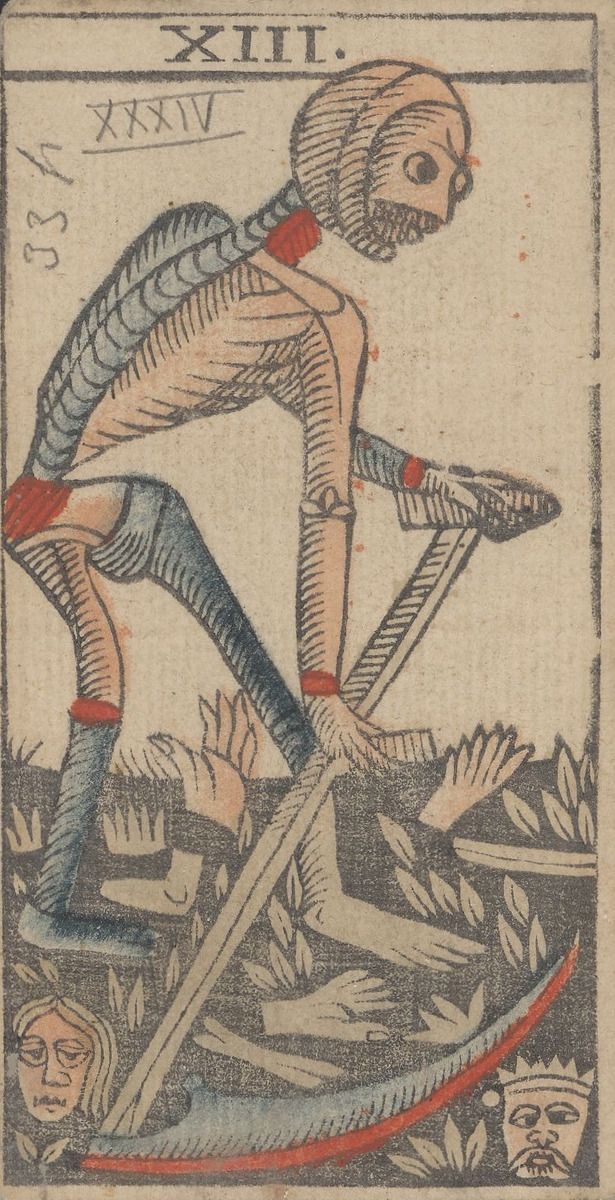
XIII (Death) — Jean-Pierre Payen, 1713. Beinecke Rare Book and Manuscript Library, Yale University. Prepared for print by Surrealium at Vaxholm Fortress, Sweden.
The Payen card bears XIII at the top and lacks the usual lower title panel. A skeletal figure holds a long, curved blade above scattered heads, hands and feet. Small plant-like forms rise from the dark ground. The body bends into its task, and the blade sweeps across the bottom of the rectangle.
The absence of a printed name is a feature of this card, not evidence that its maker was afraid to write one. Notice how the skeleton’s movement differs from the stillness of the fragments below. The image places activity and remains together in a very compressed space. In the Marseille deck story, the work belongs to a printed card tradition; the meanings supplied by later readers are another layer of its history.
Upright: describe an ending accurately
An upright Death reflection can begin with something that has actually ended or is changing: a routine, a role, an agreement or a way of working. Name the specific change before deciding what it means. A completed project does not imply the end of your usefulness; a changed relationship does not erase the time that preceded it.
Some endings are chosen and others are not. The card should not flatten that difference into a cheerful instruction to welcome transformation. You may need practical arrangements, a conversation or time to feel what you feel. The question is what can be acknowledged now, and what needs care during the change. A symbolic reading can make that question clearer without supplying a deadline for acceptance or a promise of something better.
The mounted skeleton in the painted deck
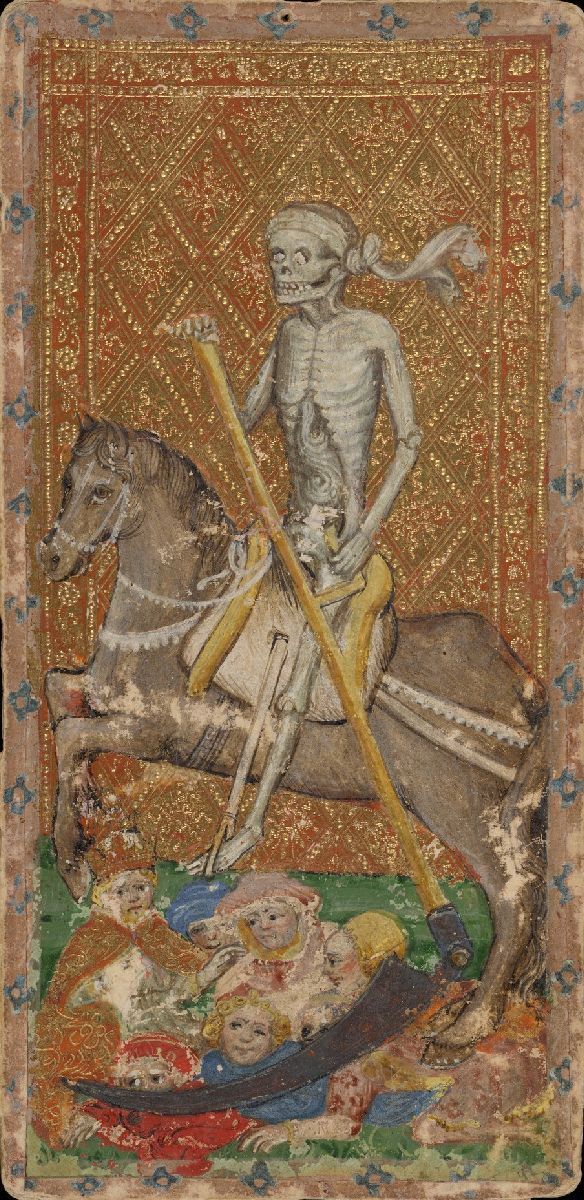
XIII (Death) — Unknown Milanese workshop, Visconti di Modrone deck, c. 1440–1445. Beinecke Rare Book and Manuscript Library, Yale University. Prepared for print by Surrealium at Vaxholm Fortress, Sweden.
In the Visconti di Modrone card, Death rides a pale horse above a group of people. The dark and gold ground, the crowded lower register and the skeleton’s weapon create a different arrangement from Payen’s field. The figure still unsettles ordinary distinctions of status, but the action is mounted rather than agricultural.
This surviving Yale card should not be confused with a newly completed version of a lost card from another Visconti pack. The collection and deck identity belong in the caption because “Visconti tarot” can refer to related but distinct objects. Compare the two actual pictures: the skeleton’s posture, the distribution of the smaller figures and the direction of the weapon. Those visible details support an art history comparison without requiring a claim about either maker’s divinatory practice.
Reversed: when change is hard to name
A reversed Death interpretation often turns towards resistance, delay or an ending that has not been fully acknowledged. These are possibilities for reflection, not discoveries made by the card. Ask whether something in your current situation fits, and leave the interpretation aside if it does not.
You might be keeping a task open because its conclusion feels disappointing, or maintaining an old routine because nobody has discussed a replacement. Alternatively, you may be taking a necessary amount of time. The card cannot tell the difference on its own. Write down what remains unfinished and what “finished” would actually involve. A concrete definition can be more helpful than a demand to let go, especially when responsibilities or other people’s needs are still part of the picture.
A living branch beside a cutting blade
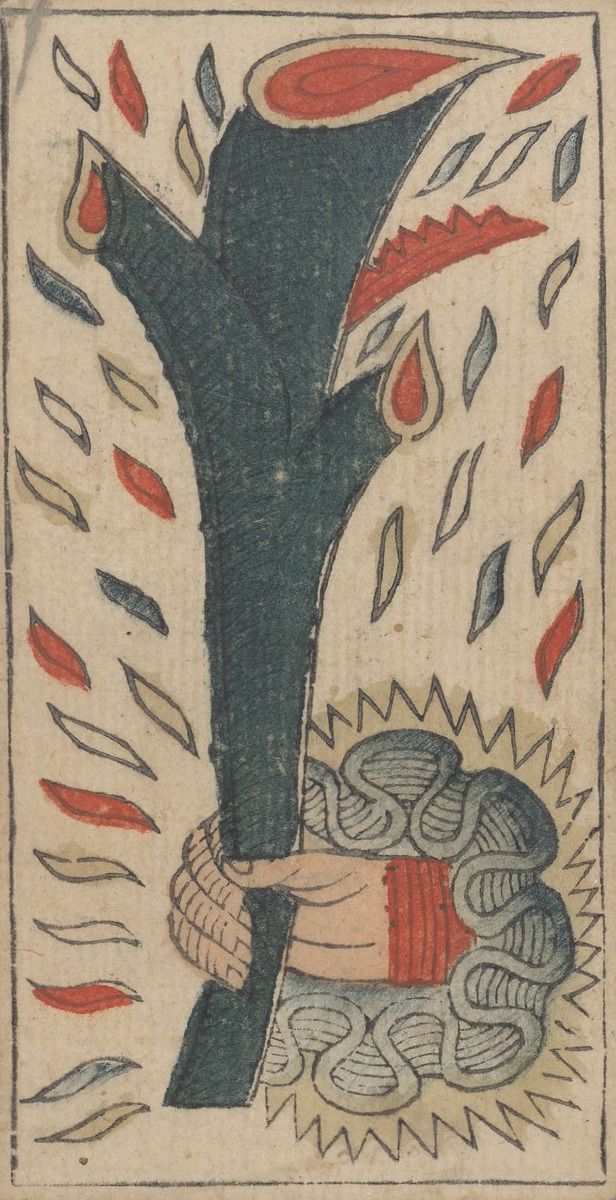
Batons Ace — Jean-Pierre Payen, 1713. Beinecke Rare Book and Manuscript Library, Yale University. Prepared for print by Surrealium at Vaxholm Fortress, Sweden.
Payen’s Ace of Batons presents a large branching staff held by a hand emerging from a decorated opening. Coloured shapes scatter around it. Beside Death’s long blade, the upright branch offers a visual contrast between a growing form and a cutting tool. That contrast is an observation, not a guarantee of renewal after loss.
XIII sits between the Hanged Man and Temperance in the Marseille sequence. A modern reader can consider suspension, ending and adjustment as related questions. It remains a chosen interpretive route. Real changes do not always arrive in an orderly progression, and a difficult ending does not become meaningful simply because a neighbouring card suggests a calmer image.
Keep what belongs to the next stage
Choose a change you can name without speculation. Make three brief notes: what has ended, what still needs attention and what you want to carry forward. The last category may include a skill, a friendship, a record of the work or a habit worth retaining. Ending one form does not require pretending it had no value.
If the image brings up a recent bereavement or an unwanted fear, you can stop. There is no obligation to turn grief into an exercise or to find a positive message in a skeleton. For a less charged subject, finish with one practical task that supports the transition. Let the reading remain a way of attending to the present, with no authority over anyone’s health, mortality or future.
- Does the Death card predict physical death?
- No. A tarot card cannot predict a death or provide information about someone’s lifespan. This story treats it as a historical image and a symbolic prompt.
- Why is there no name on some Death cards?
- The Marseille pattern shown here places XIII above the image without the usual lower title panel. That visible design feature should not be turned into an unsupported story about the printer’s motives.
- What does Death reversed mean?
- Some traditions read it as resistance or an unfinished transition. Consider those as questions about known circumstances, without assuming that change must happen on a particular schedule.