Temperance card: the work of finding a measure
Look at Payen’s historic Temperance, compare two cups, and explore upright and reversed meanings as prompts for reflection.
The Temperance card makes balance into an action. In Jean-Pierre Payen’s Marseille print, a winged figure transfers liquid between two vessels. The Two of Cups shown above is a separate comparison from the same deck, not a picture of Temperance: its paired vessels introduce the difference between a balanced arrangement and the work of bringing things into proportion. The actual Temperance card appears below. Together they offer a practical way to think about attention, adjustment and limits without treating a card as a forecast.
Watch the movement between the vessels
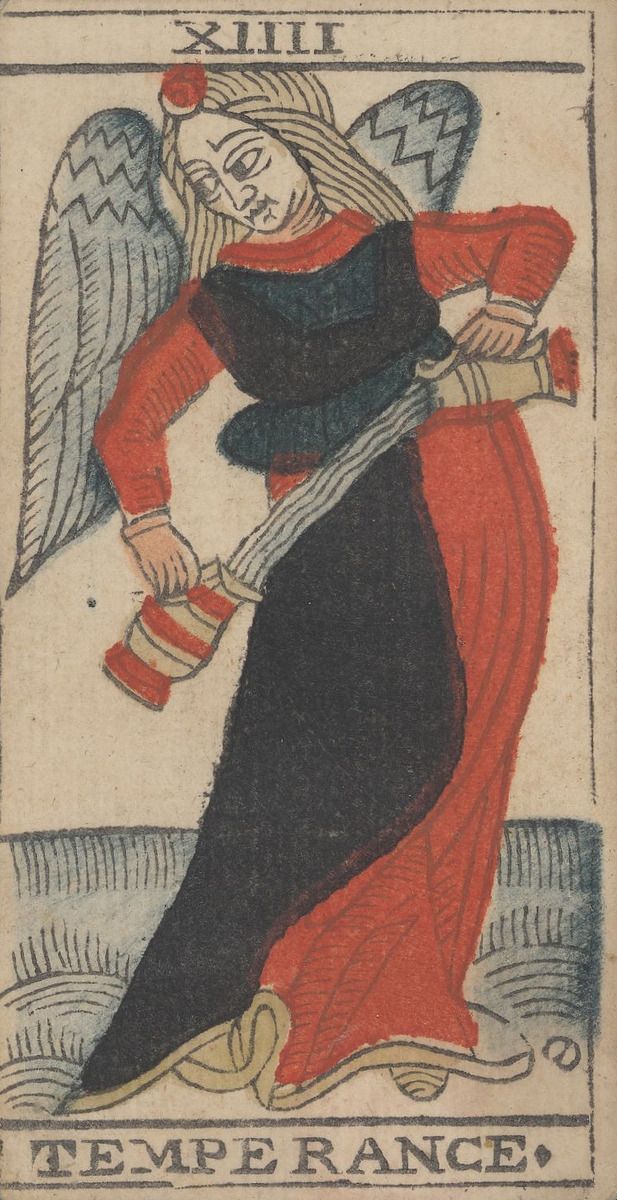
Temperance · Jean-Pierre Payen, blocks dated 1713 · Cary Collection of Playing Cards (FRA166), Beinecke Rare Book and Manuscript Library, Yale University. Prepared for print by Surrealium at Vaxholm Fortress, Sweden.
Payen’s figure wears a long garment divided into strong red and dark areas. Wings rise behind the shoulders, and the hands hold vessels at different heights. A narrow stream passes across the body from one to the other. The drawing gives that small transfer an unusual prominence: much of the image’s meaning depends on the relationship between hands, containers and the space between them.
Begin by describing what is visible before deciding what it means for you. There are two vessels, but they are not doing the same job at the same moment. One gives and one receives. The figure manages their relationship. As a reflection, that can suggest proportion, timing or the need to adjust a process while it happens. It does not establish what any particular person ought to surrender or accept.
Two cups do not always tell the same story
The paired cups in the opening image stand on either side of a decorative central arrangement. Their symmetry is quite different from Temperance’s diagonal movement. A pair of similar objects can make a stable pattern; pouring between two vessels introduces an action and a direction. That distinction helps prevent a familiar symbol from becoming a single answer applied everywhere it appears.
The Ace of Cups offers another comparison: one elaborate vessel occupies the centre of its card. Looking across the suit and the trumps, you can ask how a container is being used rather than assuming that every cup must concern romance. The Marseille deck story places these shared printed forms in their wider setting. Repetition creates connections, but the whole composition still matters.
Where Temperance sits in the sequence
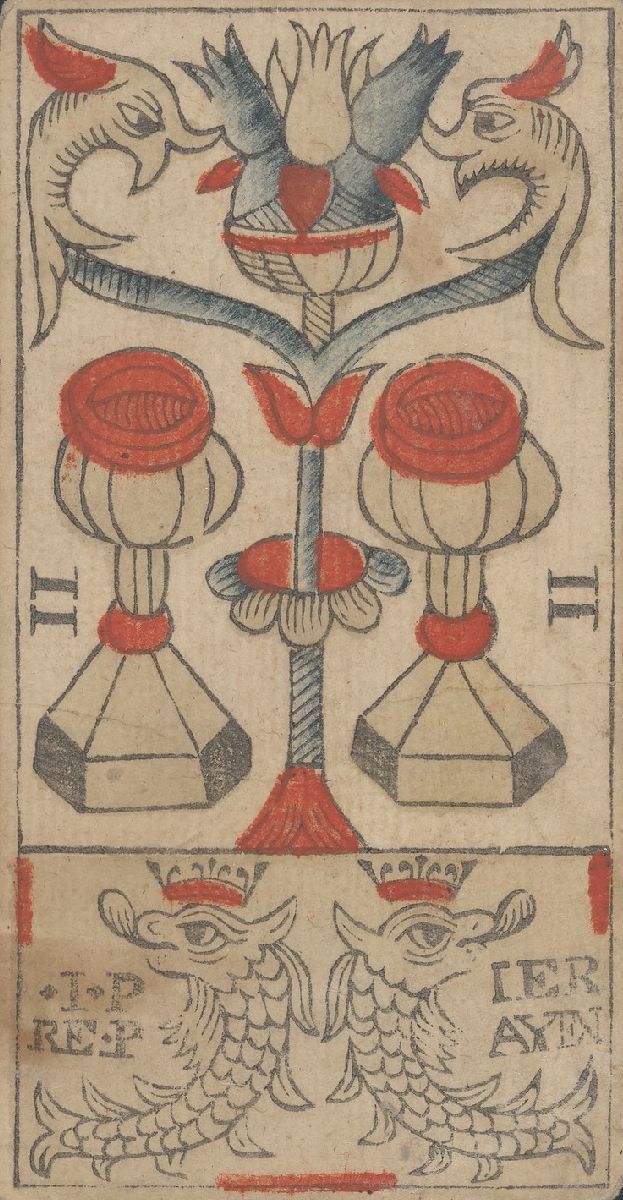
Two of Cups · Jean-Pierre Payen, Blocks dated 1713 · Payen Marseille deck, FRA 166, Beinecke Rare Book and Manuscript Library, Yale University. Prepared for print by Surrealium at Vaxholm Fortress, Sweden.
Payen’s card bears the number XIIII, fourteen written additively. In the Marseille sequence it follows the thirteenth trump, commonly called Death, and precedes the Devil. Our Death card story and Devil card story provide those neighbouring images. Their position offers a reading route, not evidence that a person must pass through a predetermined chain of events.
The major arcana guide explains the numbered trumps as a group. Temperance is a virtue figure, while the Two of Cups belongs to a suit. They can be compared visually without collapsing their different roles within a pack. Historic tarot also had a life as a game; the modern language of personal reflection should not be presented as the only purpose its earliest makers imagined.
Upright: change the proportion
An upright Temperance reading commonly begins with moderation, patience and integration. As an exercise, make those words concrete. Perhaps two useful activities compete for the same hour, or a project needs both sustained effort and a point at which you stop revising. The question is not simply how to have less of everything. It is how to give each part an amount that serves the actual purpose.
Choose one adjustable part of a situation: the length of a meeting, the time spent practising, or the number of tasks accepted in a week. Describe a modest change and a way of noticing its effect. A proportion that works today may need revising later. The card can help you pay attention to that process; it cannot calculate the correct balance or promise that every conflict can be harmonised.
Some differences should remain differences. Combining two preferences does not always produce a better outcome, and compromise is not automatically fair. Keep the needs and agency of the people involved visible. The figure’s careful handling is a useful image for an experiment you can assess, rather than a command to make every disagreement disappear.
Reversed: notice the strain
Temperance · Jean-Pierre Payen, blocks dated 1713 · Cary Collection of Playing Cards (FRA166), Beinecke Rare Book and Manuscript Library, Yale University. Prepared for print by Surrealium at Vaxholm Fortress, Sweden.
A reversed Temperance is often interpreted through excess, impatience or an uneasy mixture. Use that language to ask what is observable. Are you moving too quickly to check the result? Are demands accumulating without a clear stopping point? Is an arrangement called balanced even though one person does most of the work? These questions are more useful than treating an upside-down picture as a diagnosis of someone’s character.
Return to the stream in the historic card. The action requires a relationship between what is offered, what can be held and the pace of transfer. In your own circumstances, a limit may be the constructive response. Reducing a commitment, clarifying an expectation or allowing time before a decision can be practical changes. The card supplies an image for considering them, not evidence that a hidden force has caused the difficulty.
Moderation also does not mean enduring harm. A reading should not turn a need for safety, rest or outside support into a test of spiritual patience. Your circumstances remain the evidence. If the proposed interpretation obscures them, set it aside and return to what you know.
A short reflection on enough
Write down one thing you would like to do with more care. Then complete two sentences: “Enough for this stage would be…” and “I will review that after…”. Choose a real point at which you can look again. This keeps patience from becoming indefinite delay and keeps effort from becoming a requirement to do everything immediately.
Look once more at both cards. The Two of Cups offers a composed pair; Temperance shows an ongoing transfer. Ask whether your present question concerns the arrangement of things or the way you move between them. You may need a clearer structure, a slower action or a different division of attention. Let the difference between the pictures sharpen the question you bring to a reading. You remain free to reject an interpretation that does not fit the situation.
- Is Temperance a yes or no card?
- A card cannot establish the outcome of a decision. Temperance can prompt questions about proportion and patience, but the relevant facts still need to be checked.
- Why does this historic card say XIIII?
- Payen’s Marseille card uses an additive form of fourteen. It occupies the position between the thirteenth trump and the Devil.
- Is the opening picture also Temperance?
- No. The opening image is Payen’s Two of Cups, used as a labelled visual comparison. The winged figure pouring between vessels is the Temperance card shown in the article.