Knight of Cups: an offer carried carefully
Look at two historic mounted figures, then consider invitation, imagination and follow-through as reflective meanings.
The Knight of Cups carries an object that could easily spill. That simple observation offers a more useful beginning than treating the card as a promise that someone romantic is about to arrive. Payen’s rider holds the cup upright on a carefully outfitted horse; the older Cary-Yale pack includes a mounted woman with the same suit. Together they make a story about how an offer is presented, how it travels and whether its bearer can carry it through.
The cup above the moving horse
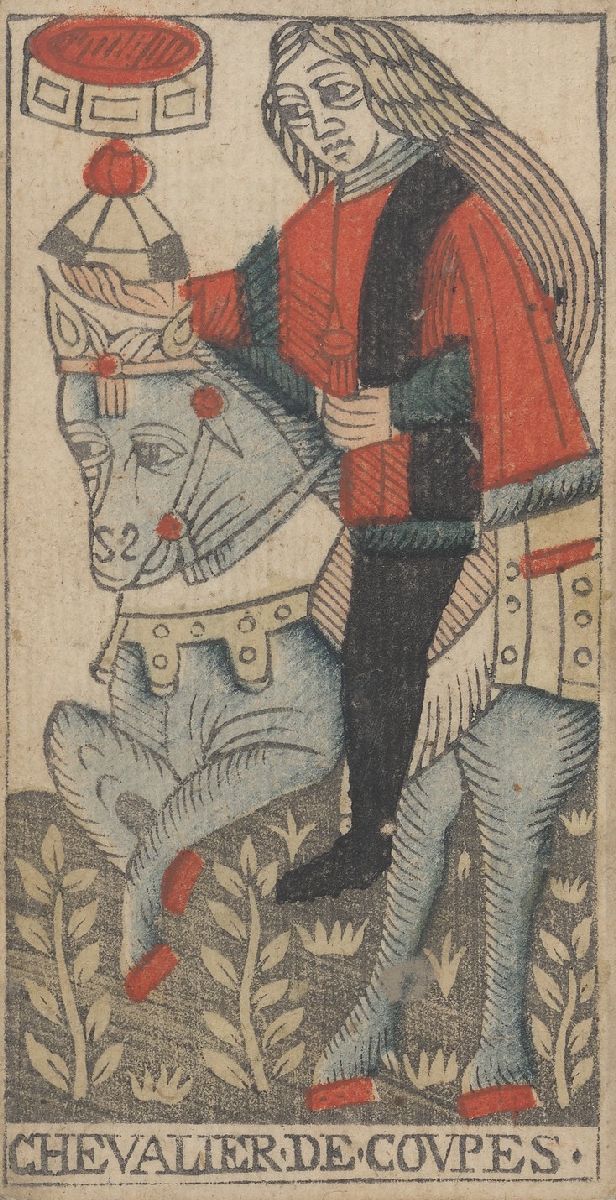
Knight of Cups · Jean-Pierre Payen, Blocks dated 1713 · Payen Marseille deck, FRA 166, Beinecke Rare Book and Manuscript Library, Yale University. Prepared for print by Surrealium at Vaxholm Fortress, Sweden.
In Payen’s image, the rider’s cup rises near the upper corner while the horse fills the lower half. The animal’s head, the decorated tack and the rider’s upright body divide the small space into distinct shapes. This is a court card: a figure occupies a rank within the suit rather than a numbered scene with a written moral.
The cup is held visibly, not hidden in a bag. For a modern reflective reading, that can suggest an offer being made openly. Yet the card does not identify its contents or the destination. We should not invent those details and then pretend they were evidence. You might ask what an invitation contains in practical terms: a date, a place, a clear intention, or merely an attractive impression. That question comes from attending to the object and the gesture, not from predicting the rider’s arrival in your life.
A woman among the mounted court
The surviving Cary-Yale mounted woman is an important reminder that historic tarot courts did not all use exactly the same personnel. The surviving card shows a female mounted court figure carrying a cup, a counterpart to the familiar male Knight. Her patterned costume, ornamented horse covering and gold ground create a different atmosphere from Payen’s printed rider. She is not a newly imagined reconstruction.
Read the Cary-Yale deck introduction for the wider pack. The distinction is worth retaining whenever you compare cards: the name used by a modern reading interface can simplify an older object’s identity. A careful caption keeps the historic figure visible instead of silently converting her into a man. Neither sex nor costume determines who may recognise themselves in the role of carrying an invitation, a proposal or an idea to someone else.
A court rank, not a major trump
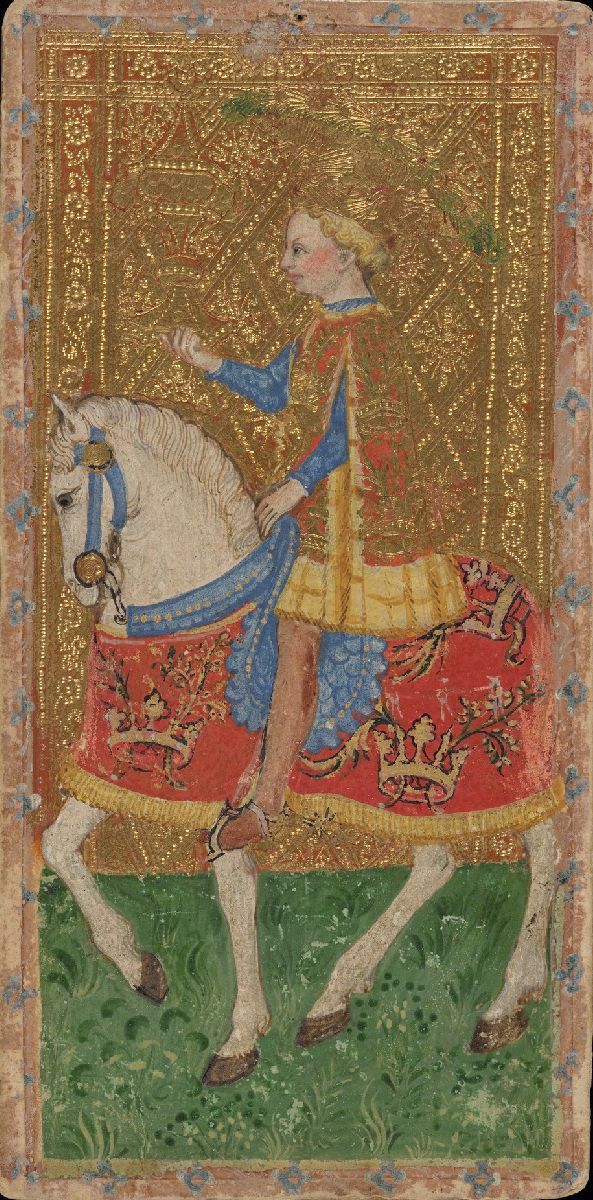
Mounted woman with a cup (female Knight of Cups) · Unidentified Milanese workshop, c. 1442–1447 · Visconti di Modrone (Cary-Yale) deck, GEN 965, Beinecke Rare Book and Manuscript Library, Yale University. Prepared for print by Surrealium at Vaxholm Fortress, Sweden.
The Knight belongs to the minor arcana, in the suit of Cups. In the familiar four-rank sequence, the Page precedes the Knight and the Queen follows it. The Marseille deck guide places those neighbouring ranks in their wider setting. Compare the figure on foot, the mounted messenger and the seated ruler: each brings a different kind of presence to the same suit.
Unlike the figures discussed in the major arcana guide, a court card is often read as a manner of acting, a role in a situation or an aspect of the reader’s own approach. It need not represent a particular person. The distinction helps when the question concerns a relationship: an attractive symbolic description should not become a claim that you know what someone else secretly intends.
Upright: make the invitation clear
Modern readings often connect the upright Knight of Cups with imagination, affection or an offer made with feeling. A useful application is to examine how you express interest. Have you said what you would like to share, or have you left the other person to infer it? Is there room for an answer different from the one you hope for? An invitation is more generous when declining it is possible.
The same approach works for creative work. A proposal may be moving because the person presenting it cares deeply, but the recipient still needs to understand its shape. State the idea, the request and the next step. The Knight’s cup can stand for feeling carried in a form another person can receive. It is not necessary to flatten that feeling into a businesslike script; it is necessary to give it enough clarity to travel beyond your own imagination.
Reversed: test the distance between words and action
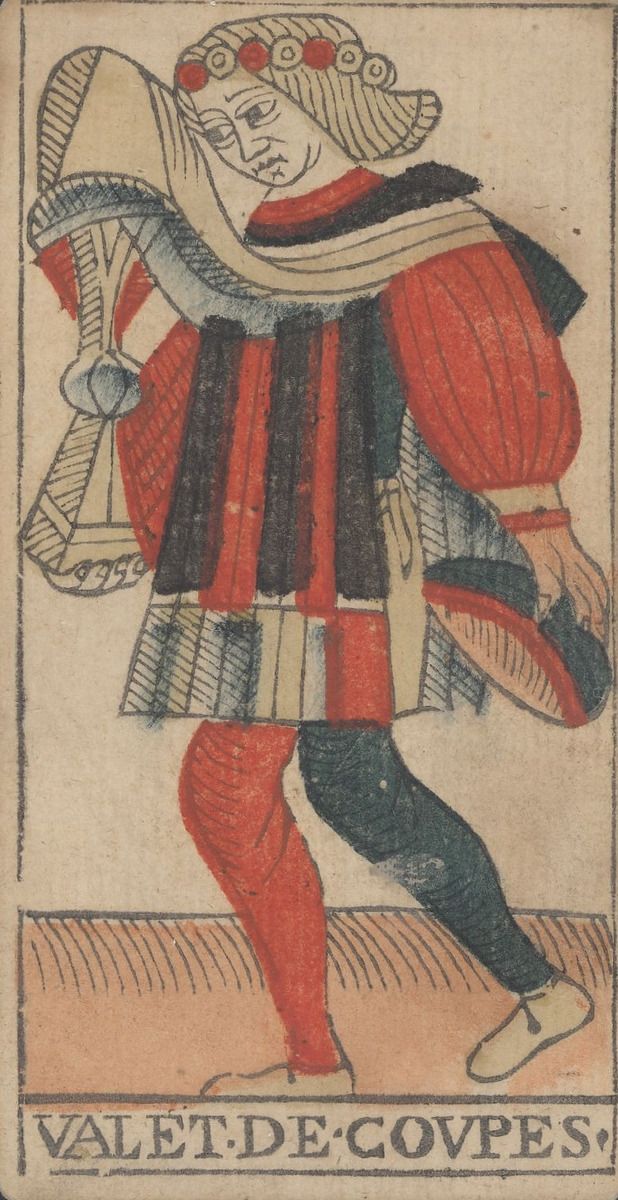
Page of Cups · Jean-Pierre Payen, Blocks dated 1713 · Payen Marseille deck, FRA 166, Beinecke Rare Book and Manuscript Library, Yale University. Prepared for print by Surrealium at Vaxholm Fortress, Sweden.
A reversed Knight is often interpreted through an offer that remains vague, mood that outruns commitment or charm without sufficient follow-through. Use those possibilities to examine observable behaviour. A missed arrangement, an unclear request or a repeatedly postponed conversation can be discussed directly. The card is not evidence that someone is deceitful, and it cannot establish a motive you have not asked about.
The Page shown beside this section provides a quieter comparison: the cup is carried on foot rather than from horseback. You might read that as a smaller beginning, with less ceremony and a more immediate task. If your own proposal has become too grand to deliver, reduce it. Offer one piece of work, one useful conversation or one manageable plan. Scale is not a measure of sincerity. An achievable gesture may carry more care than a dramatic promise.
Write the offer in one sentence
Complete the sentence “I would like to offer…” with something concrete. Underneath, write what you can actually commit to and what remains uncertain. If the offer involves another person, leave space for their preferences. The exercise is deliberately ordinary: it turns the image’s invitation into a question about communication and responsibility.
Then compare the Knight’s cup with the more architectural vessel in the Ace of Cups. The Ace can prompt reflection on capacity before an offer takes shape; the Knight concerns carrying something into contact with the world. You do not need to decide that one card predicts a beginning and the other an arrival. Let their different pictures help you separate a feeling, a proposal and an action. That distinction is useful whether the subject is affection, friendship or a piece of creative work.
- Does the Knight of Cups mean someone will contact me?
- No card can confirm another person’s future action. It can help you think about invitations, communication and what you want to offer.
- Is the Knight of Cups a man?
- Not necessarily in a reflective reading. The Cary-Yale example shown here is a surviving female mounted court card, captioned accordingly.
- What comes before and after the Knight?
- In the usual four-rank Cups court, the Page comes before the Knight and the Queen follows. Historical packs can contain different court arrangements.