The Empress card: authority, care and what can grow
Two historic Empresses show crowns, attendants and an eagle. Read their differences before turning to symbolic meanings.
The Empress card is often reduced to a promise of abundance. Its older pictures are more specific and more interesting: a crowned woman holds authority, displays an eagle and occupies a carefully arranged social world. In the Cary-Yale card, attendants gather around an imposing golden figure; in Payen’s Marseille version, the ruler is compressed into a strong printed silhouette. These are historic images of rank. Care, creativity and growth are later interpretive possibilities, not evidence that a card can predict a pregnancy or a relationship.
A court gathered around one woman
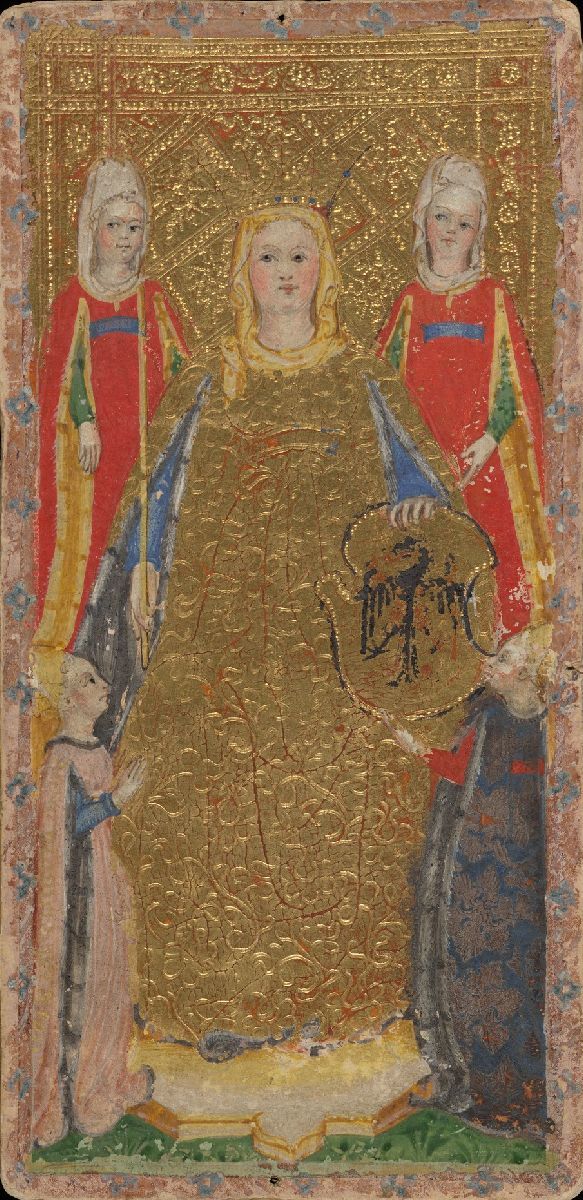
The Empress · Unidentified Milanese workshop, c. 1442–1447 · Visconti di Modrone (Cary-Yale) deck, GEN 965, Beinecke Rare Book and Manuscript Library, Yale University. Prepared for print by Surrealium at Vaxholm Fortress, Sweden.
The Cary-Yale Empress rises through the middle of the card in an elaborately patterned gold garment. Figures flank her at different heights, and a dark eagle stands out on the shield she carries. The surface makes hierarchy visible through scale, position and richness. Gold is not merely a pleasant background colour here: it gives the central figure an exceptional presence even before we identify any symbol.
This card survives from the fifteenth-century Visconti di Modrone pack at Yale. It belongs to a courtly visual culture, rather than the green landscape most modern readers associate with the Empress. Look at how much of the picture is occupied by people and costume. An interpretation grounded in this image might begin with responsibility, access and the people who support a position of authority. It need not begin with an idealised idea of womanhood.
The printed Empress keeps her emblem
Payen’s Empress has a crown, a sceptre and an eagle-bearing shield. The narrow card replaces the Milanese court’s rich surface with firm contours and a small set of colours. Yet the figure remains recognisable. The eagle is a heraldic attribute of imperial rank; it should not be treated as a random decorative bird or a private message about the person looking at the card.
The Cary-Yale deck story introduces the older pack, while the Marseille art story follows the printed tradition. Comparing them teaches a useful habit: identify what persists, then notice what changes. Attendants, posture, garments and space all affect the impression of a ruler. A modern keyword may be shared by both cards, but it cannot replace the act of looking at either one.
Where she sits in the sequence
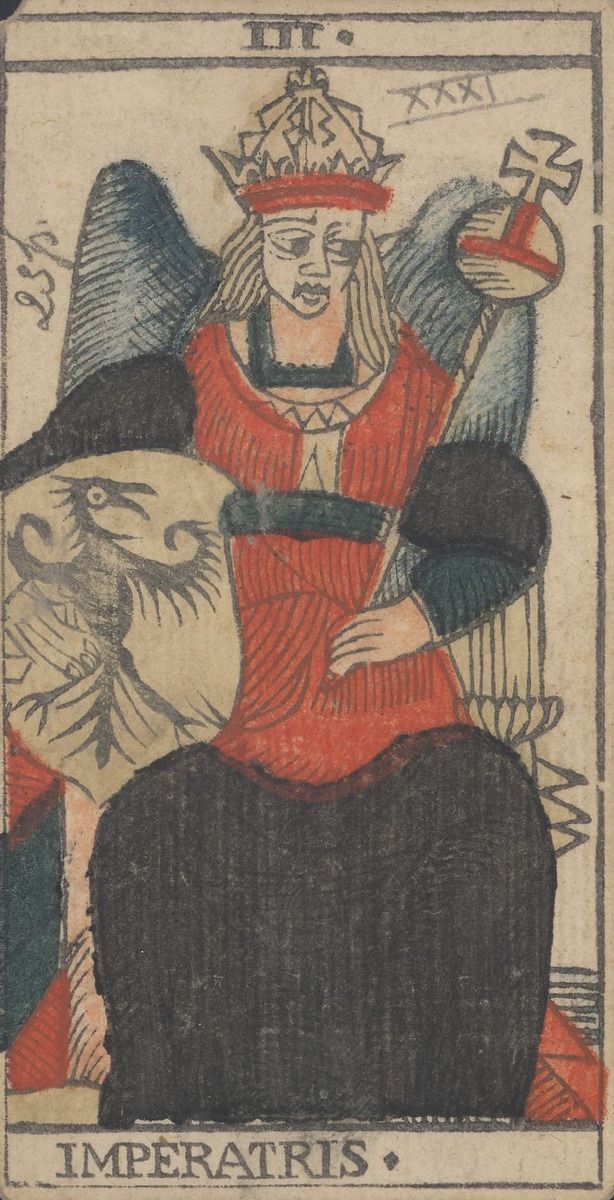
The Empress · Jean-Pierre Payen, Blocks dated 1713 · Payen Marseille deck, FRA 166, Beinecke Rare Book and Manuscript Library, Yale University. Prepared for print by Surrealium at Vaxholm Fortress, Sweden.
In the Marseille sequence the Empress is III, between the Popess and the Emperor. Our neighbouring stories on the High Priestess and the Emperor let you compare the book, the shield and the different presentations of authority. These figures are roles within a historic symbolic world, not a compulsory sequence of gender roles for a modern reader.
The distinction matters when someone approaches the card through a creative project or the care of another person. You can ask about resources, maintenance and influence without assigning those activities exclusively to women. The broader major arcana guide places the image among rulers, virtues and dramatic events. Its meaning becomes richer in that company than it does as an isolated promise that everything will flourish.
Upright: provide the conditions
An upright Empress is commonly read through nurture, material comfort and creative development. For reflection, shift the emphasis from an outcome to its conditions. What does the thing you care about require today? A plant needs an appropriate place and regular attention; a shared project may need a clear brief, time and someone willing to do the unglamorous work. Wishing for growth is different from making room for it.
Care also involves listening. If you are helping another person, ask whether your version of support matches what they want. A gift, a meal or a practical favour can be generous without becoming a demand for gratitude. The Empress’s authority can remind you that resources carry choices: what you fund, protect or make accessible affects others. The card offers a language for considering those choices, not a verdict that your intentions are automatically beneficial.
Reversed: care without taking over
The Empress · Unidentified Milanese workshop, c. 1442–1447 · Visconti di Modrone (Cary-Yale) deck, GEN 965, Beinecke Rare Book and Manuscript Library, Yale University. Prepared for print by Surrealium at Vaxholm Fortress, Sweden.
A reversed reading may explore neglect, depletion or care that becomes control. These are questions to investigate, not labels to attach to someone’s character. A person can be attentive in one part of life while leaving another unsupported. Equally, an elaborate plan to help can make its recipient feel crowded if they have no say in it.
The attendants in the older picture offer a useful visual prompt. Who is carrying the work around the central figure? Is that support acknowledged? Apply those questions to an actual arrangement: a household, a collaboration or the practical demands of making something. You may discover that care needs to be shared, or that a simpler plan would be kinder. Nothing in a reversed card establishes illness, infertility or another person’s hidden feelings. Such claims go beyond what a symbolic image can tell you.
A reflection with a practical ending
Choose one thing you want to sustain rather than merely start. Draw three small columns on a page: what it receives, what it needs and what you can realistically offer. Keep the last column modest. If a task requires help from someone else, write that down instead of silently assigning yourself the whole responsibility.
Now return to the Empress and describe one feature of authority that you admire and one that makes you uneasy. The same image can hold both. You might value its steadiness while questioning the hierarchy around it. That is a productive reading: a picture has helped you articulate a judgement rather than replacing your judgement. Bring a question of that size to the reading desk, where the historic card can remain a companion to thought instead of becoming an answer in advance.
- Does the Empress predict pregnancy?
- No. Fertility is part of some symbolic readings, but a tarot card cannot establish pregnancy or reproductive health.
- Why is there an eagle on the shield?
- The eagle belongs to the card’s imperial imagery. It survives in both historic examples shown here, despite substantial differences in costume and composition.
- Can anyone read themselves through the Empress?
- Yes. Care, creativity, authority and resources are human concerns. You do not need to adopt a prescribed gender role to reflect on them.