Signet ring design: from an emblem to a clear seal
Understand signet ring design through the difference between a decorative emblem, a readable engraving and a working seal.
A signet ring places an identifying design on a small face. Historically that face could be used to impress a mark in a sealing material; today the interest may be the emblem itself, the act of sealing or the pleasure of wearing a personal design. Those purposes overlap, but they should be distinguished before a drawing is treated as ready for a ring.
The images in this guide are historical armorial compositions and actual Fable Heraldry demonstrations. They are not photographs of rings or examples of finished metalwork. They help explain which parts of a design might survive reduction and which should be simplified before a specialist engraver assesses them.
If you are starting from a crest idea, read what a coat of arms is and the existing guide to a family crest signet ring. Fable Heraldry can help you create a new decorative emblem. A ring, its engraving and any functional sealing requirements need their own specific discussion with the maker.
Decide whether the design is for looking or sealing
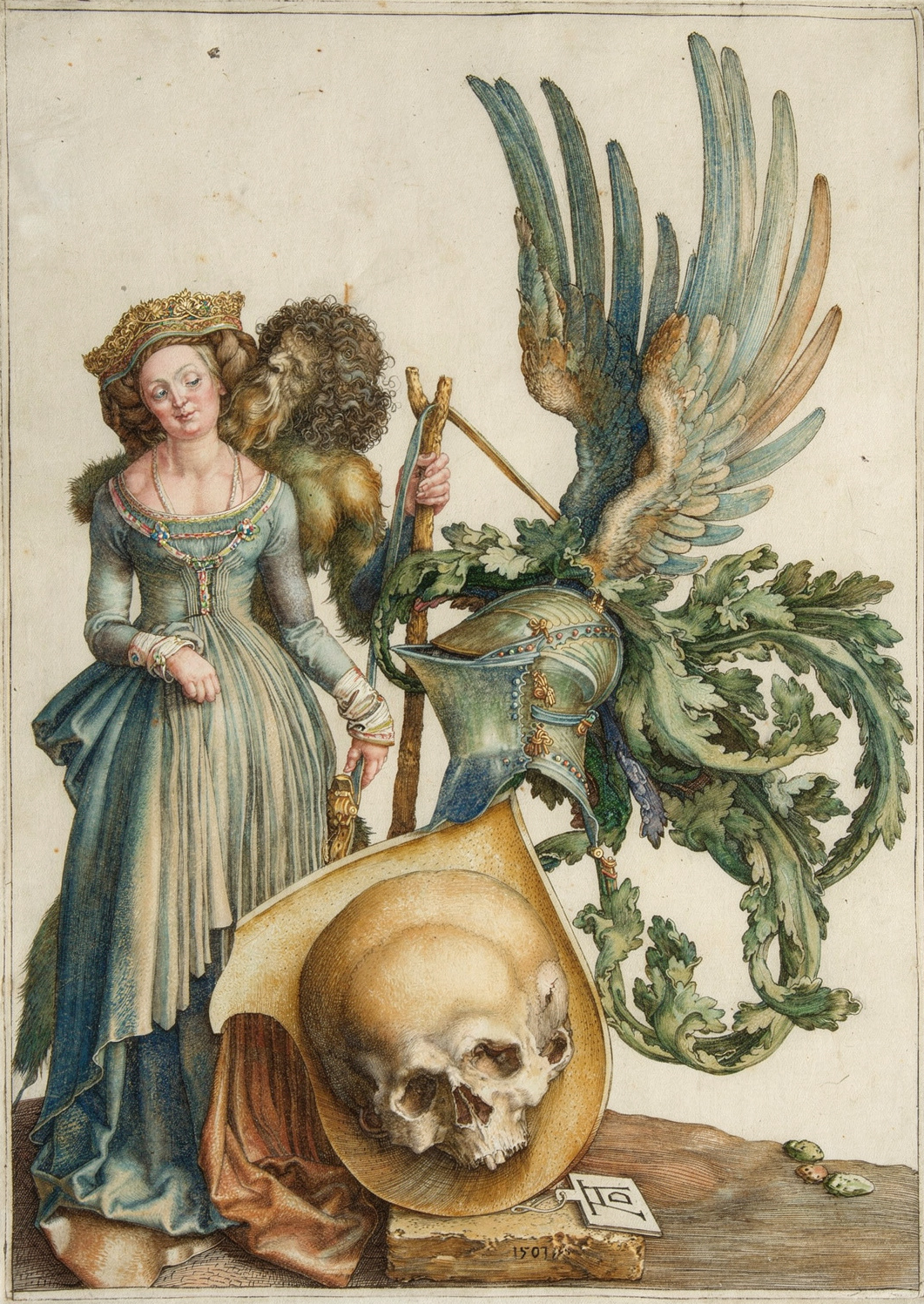
Coat of Arms with a Skull · Artist: Albrecht Dürer, 1503 · The Metropolitan Museum of Art. Contemporary Fable colour edition after the historical print. Restored by Surrealium at Vaxholm Fortress, Sweden.
A decorative image on a ring is read directly by the person looking at the ring. A working seal is read in the impression it leaves. That difference becomes especially important for letters and any element whose direction matters. Do not assume that a drawing which looks right on screen is already prepared for the intended process.
Write the purpose at the top of the brief: a ring to wear, a ring to make a readable impression, or both. Then ask the maker how the design should be supplied and reviewed. The guide to custom wax seals develops the related stationery use. It is better to establish the purpose before adding details than to discover at the end that a beautiful decorative drawing asks for a different kind of engraving from the one you expected.
Read the whole armorial composition first
Dürer’s Coat of Arms with a Skull contains far more than a shield. A helmet, elaborate wings, a standing woman and another figure make a substantial narrative composition around the central emblem. The version shown is a contemporary Fable colour edition after the historical print, so the present colour is not evidence of the original print’s colour scheme.
The work is useful because it makes the problem of scale visible. A full armorial image may be compelling on a page while containing more information than a small ring face can communicate. Before selecting an element, identify what it is and why it matters. A shield, a crest above a helmet and an entire achievement are different choices, and each carries a different amount of visual information into the maker’s assessment.
Choose one clear principal shape
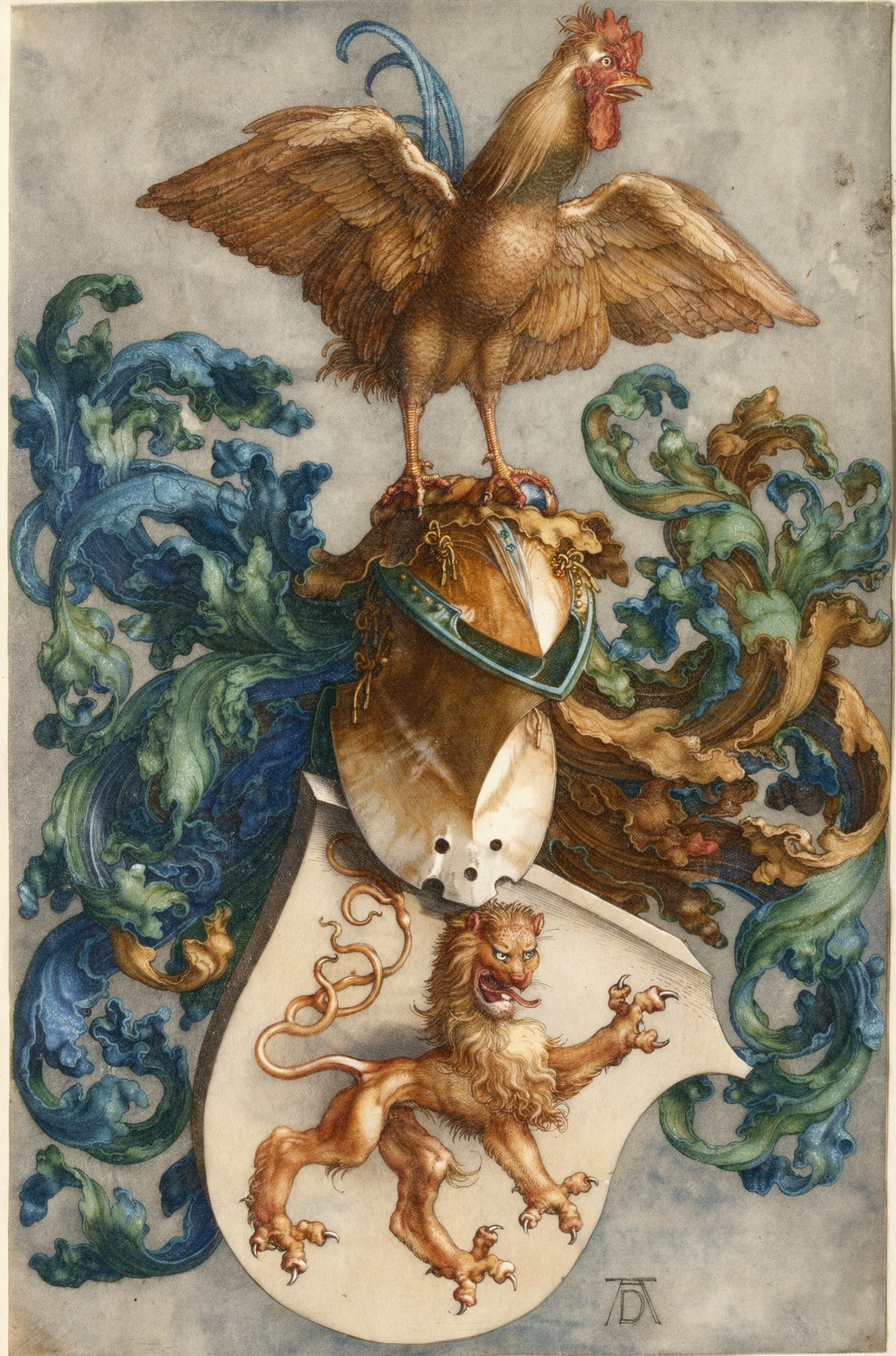
The Coat of Arms with a Lion and Cock · Albrecht Dürer, probably 1503 · Cleveland Museum of Art. Contemporary Fable colour edition after the historical print. Restored by Surrealium at Vaxholm Fortress, Sweden.
In Dürer’s lion-and-cock design, the lion occupies the shield while the bird stands above the helmet. The distinction between those positions helps you see two possible subjects rather than one inseparable decorative mass. The whole masterwork makes that organisation easier to inspect.
For a new decorative ring design, begin with the principal shape you want someone to recognise. It might be an animal, a plant, a tool or a monogram with a personal reason behind it. Do not decide that every leaf of the surrounding ornament must remain. A drawing can retain the idea of a larger composition through a simpler silhouette, but the engraver should determine what is appropriate for the actual face, material and method.
Keep ancestry claims separate from design preferences
A surname printed beneath an emblem does not establish that the bearer has inherited historical arms. If that is the purpose of the ring, the research must concern a specific person, a specific record and the relevant line of descent. A visually similar design found in a surname search cannot supply that evidence by itself.
A new personal emblem is a different project. You can explain it through your own interests, places and values without describing it as an ancestral grant. The surname crest guide helps keep those questions apart. This distinction is practical as well as historical: a clear brief tells the maker whether they are reproducing an established design from documentation or helping translate a contemporary decorative idea into a small object.
Test the hierarchy before the ornament
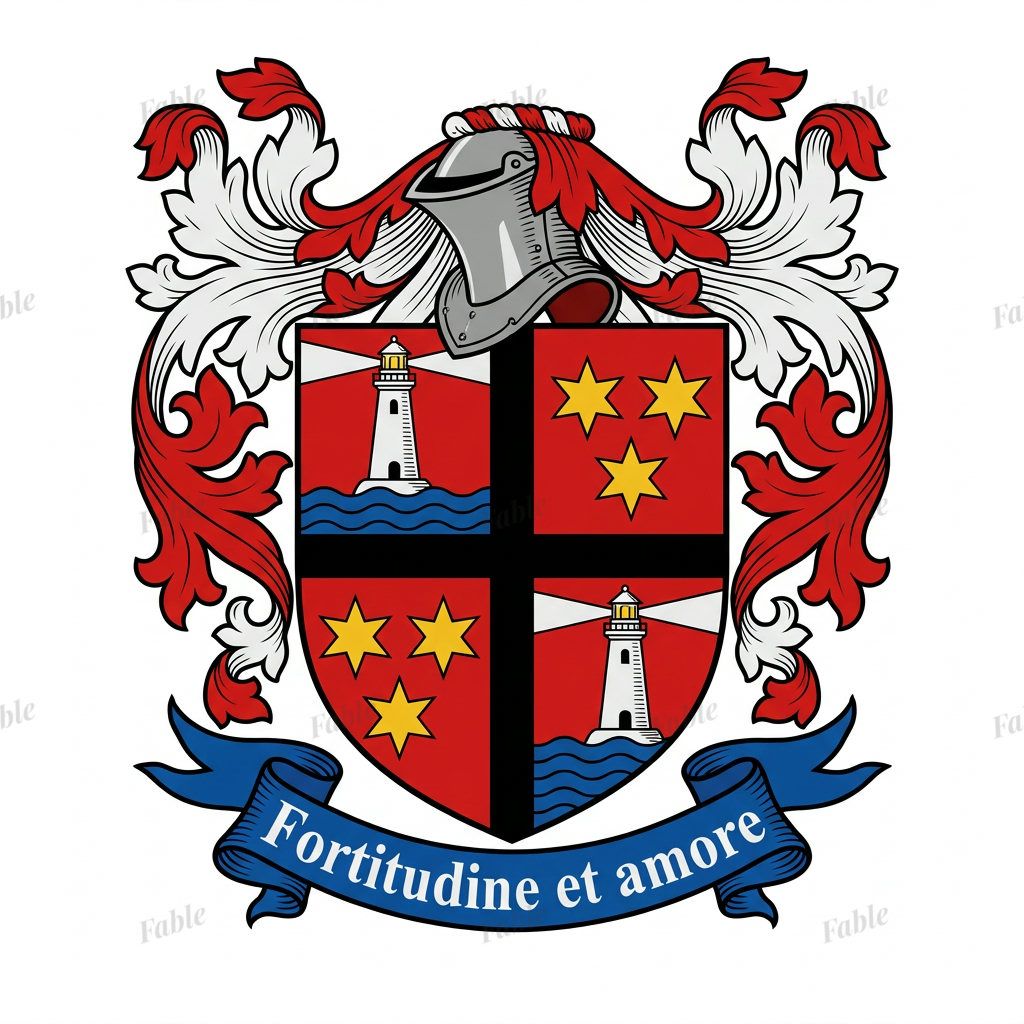
Fable crest demonstration · Fable · 2026 · Actual decorative Fable Heraldry output; not historic arms or a customer testimonial. Fable product demonstrations.
The Fable crest demonstration shown here has a quartered shield, stars, towers, mantling and a motto ribbon. It is an actual decorative Fable output, not a historical grant or a customer testimonial. At a generous screen size its parts can be followed one by one; at a smaller scale they compete more strongly for attention.
Print or display your draft near the intended viewing size and ask what you recognise first. If the main symbol disappears while the border remains obvious, reconsider the hierarchy. This is an informal design check, not a substitute for an engraving proof. Keep a full version of the emblem if you want it for larger stationery, and let the ring version be assessed on the information it can clearly communicate in its own setting.
Treat lettering as a separate design decision
A short word, a pair of initials and a complete motto place very different demands on a small surface. Choose the wording for its meaning first, then ask whether it belongs on the ring face, elsewhere on the object or in the accompanying presentation. A meaningful phrase does not have to be squeezed into the most difficult position to remain part of the gift.
Our family motto guide offers original starting points for a new decorative design. If you want a phrase in another language, verify its spelling and grammar before an engraving proof is prepared. Keep the exact approved wording in the brief, including accents and punctuation, so that a later review is a comparison against a clear text rather than a memory of how you thought the phrase should look.
Use colour to plan, not to imply a metal result

Winery crest demonstration · Fable · 2026 · Actual decorative Fable Heraldry output; not historic arms or a customer testimonial. Fable product demonstrations.
The winery demonstration uses strong blue, yellow and red areas, with a sun above the shield and several motifs within it. Those colour divisions make the image readable as a coloured design. They do not show how the same information will appear in an engraved surface, where depth, line and light may carry distinctions that colour currently supplies.
Ask the maker to explain the proposed translation. Some details may need a different treatment, and a shaded illustration is not automatically a production drawing. Keep the visual reference and the manufacturing proof clearly labelled as different stages. The purpose of the reference is to explain the intended emblem; the purpose of the proof is to show what the maker proposes to make for the particular object you have discussed.
Finish with a brief the maker can answer
Gather the purpose, principal symbol, exact wording and any historical documentation into a concise brief. Include the complete reference image and explain which parts are essential to its identity. If you are uncertain whether an element can remain clear, mark that as a question rather than quietly assuming it will work.
Review the maker’s proof for direction, spelling, spacing and the relationship between the main symbol and its boundary. Keep the design’s personal story in an accompanying note if it is too detailed to express on the object itself. Begin with a decorative emblem in Fable Heraldry and bring the resulting design to your chosen maker. A clear visual starting point helps you discuss what can be simplified, retained or reworked for the ring you have in mind.
A successful signet design begins with a recognisable idea and a precise purpose. Decide what the image should identify, distinguish a new emblem from documented historical arms, and let the maker assess its translation into the object. You can start by developing the decorative crest, then use that design and its explanation to ask informed questions about engraving and sealing.
- Is every ring with an emblem a working signet?
- A ring may carry a decorative emblem without being prepared to make a readable seal impression. Confirm the intended function and engraving treatment with its maker.
- Can I use a whole coat of arms on a small ring?
- That depends on the design and the maker’s process. A full achievement can contain more detail than a small face will communicate, so discuss simplification and review a specific proof.
- Does Fable Heraldry establish a right to inherited arms?
- No. A new decorative design is not a grant, a registry entry or proof of descent. Historical entitlement is a separate research question.