Spanish coat of arms: kingdoms within one shield
Read the main elements of Spain’s arms, distinguish historical versions, and plan a personal design without borrowing a state identity.
The Spanish coat of arms brings several historical identities into one composition. A castle, a lion, bands, chains and a pomegranate are not a random collection of decorative motifs; they belong to a defined national emblem with a particular history. Understanding the parts is the first step. Understanding which version you are looking at is the second. The Fable vineyard example shown here is a contemporary demonstration of divided-shield design, not Spain’s arms or a historical Spanish family achievement.
Read the principal elements in order
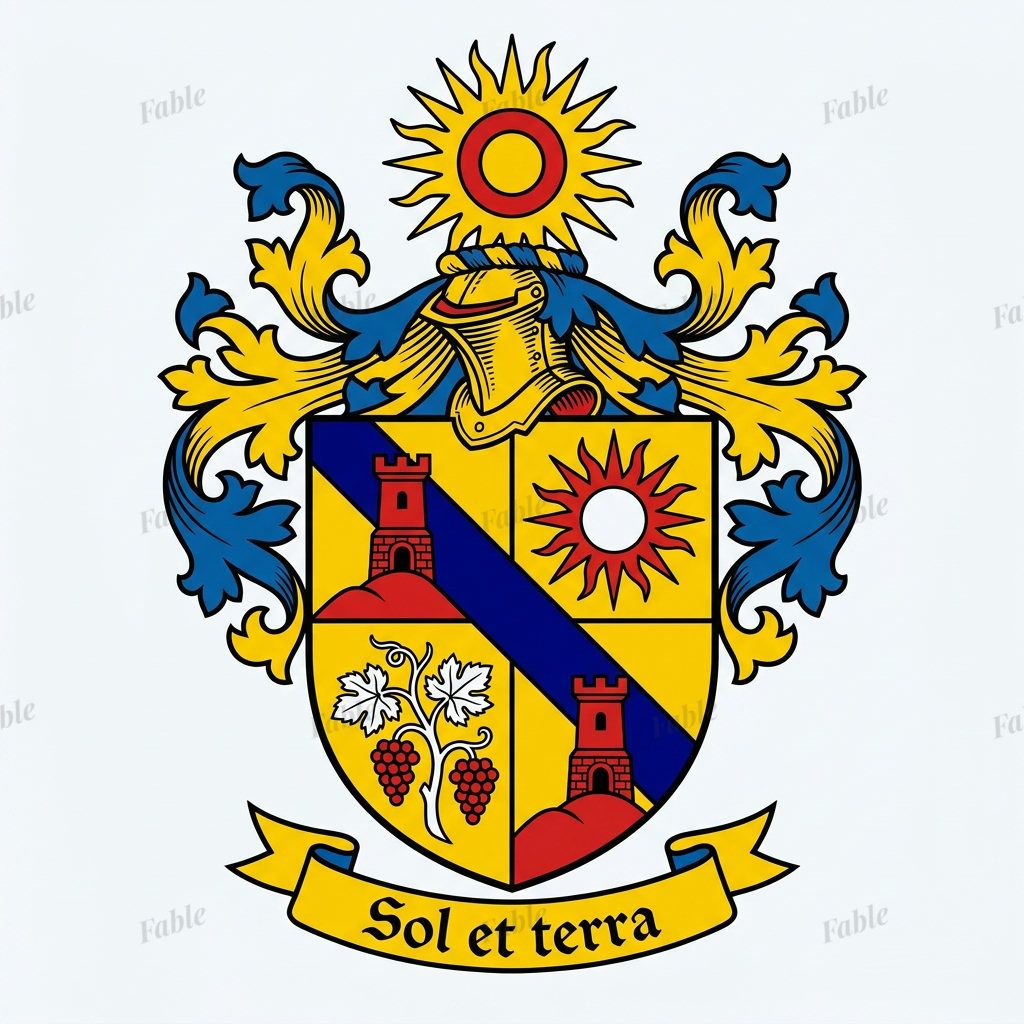
Fable vineyard crest demonstration · Fable Heraldry, 2026 · Fable approved web examples. A contemporary decorative design; not historic arms or a customer testimonial.
The current national shield combines the castle of Castile, the lion of León, the red-and-gold pattern of Aragon, the chains of Navarre and the pomegranate of Granada. A smaller central shield carries Bourbon-Anjou fleurs-de-lis. The crown, pillars and motto form part of the fuller national display. Spain’s government describes the current emblem through the legislation and official model established in 1981, with later technical colour specifications.
That description gives a starting point, not permission to label every old shield with similar elements as the current arms. Count the divisions and note what appears in each one. Look for additions, omissions and a different central shield. Those details can help locate the image in a historical setting before you interpret its meaning.
The contemporary vineyard demonstration alongside this section also uses divisions, towers and a sun, but its composition is a new Fable example with the motto Sol et terra. It is included only to illustrate how separate areas can be organised within a decorative shield. Its towers are not evidence of Castilian identity, and its grapes do not turn it into an official regional emblem.
Quartering makes relationships visible
A divided shield can bring several armorial identities together. The arrangement is part of the information: moving a charge, changing a field or replacing a central shield can change what the whole display identifies. This is why a simplified image should be checked against a source rather than treated as self-explanatory. An elegant drawing can still omit the detail needed to name it correctly.
Begin with a plain inventory in words. Describe the upper-left area as you see it, then the upper-right and the lower sections, noting that heraldic right and left are conventionally understood from the bearer’s perspective. Record a central shield separately. Only after that inventory should you match the elements to named kingdoms, dynasties or institutions.
Our heraldry introduction explains the vocabulary of fields and charges. The aim is not to make the description sound grander. It is to make your observation repeatable, so someone else could look at the same image and understand how you reached the identification. Good terminology helps distinguish a castle from a single tower and a field pattern from an object placed on top of it.
The date changes the reading
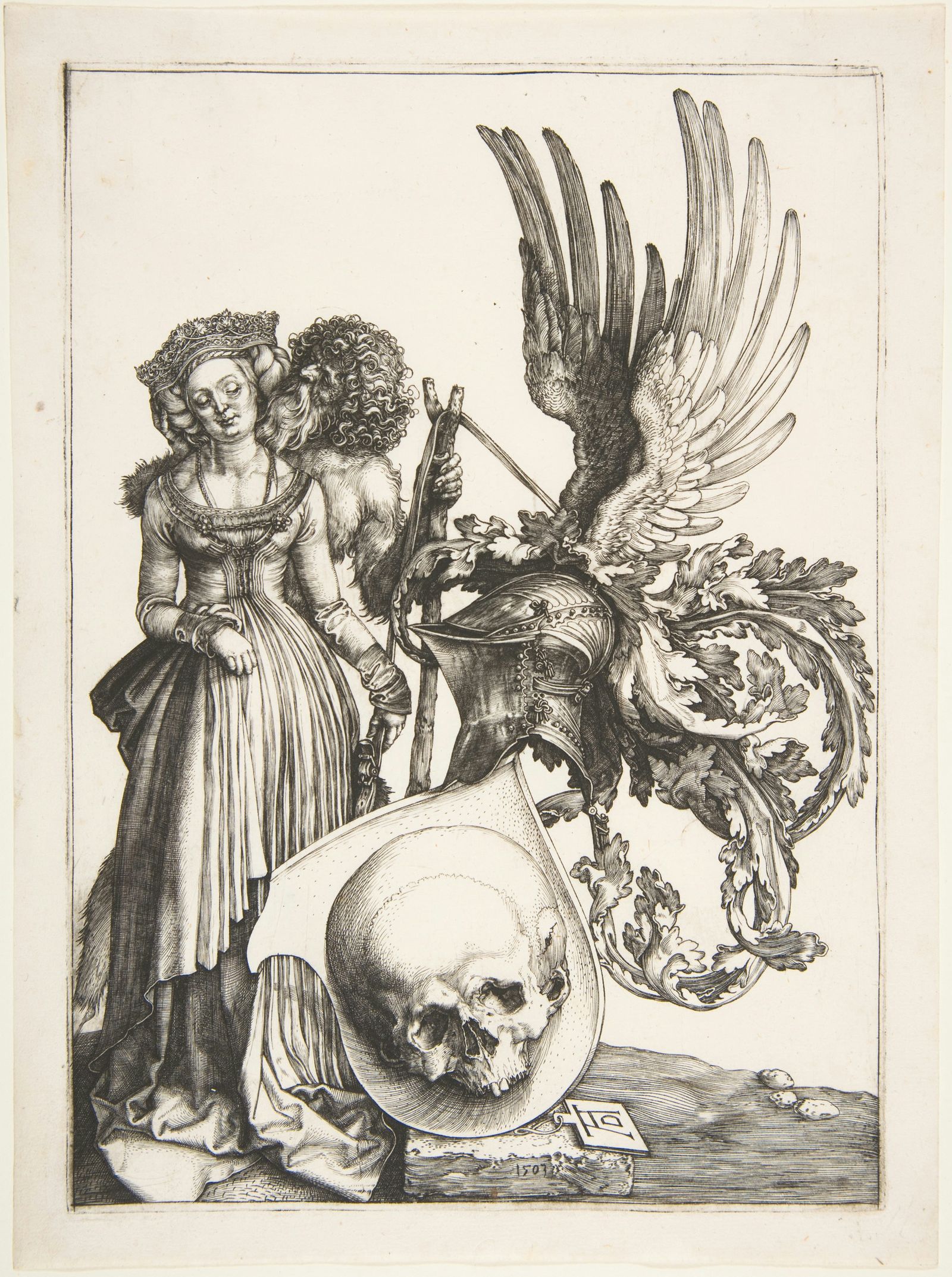
Coat of Arms with a Skull · Albrecht Dürer, 1503 · The Metropolitan Museum of Art. Prepared for print by Surrealium at Vaxholm Fortress, Sweden.
Spain’s government history of the emblem follows successive dynastic and political versions. The arms of the Catholic Monarchs, Habsburg rulers, Bourbon rulers and republican periods are not all identical. A crown, a central device or an added quarter can carry a historical distinction. The present national model should therefore not be projected onto every earlier image associated with Spain.
The Dürer engraving shown here is a German Renaissance comparison for the structure of a heraldic composition. It is not a Spanish armorial source. Its helmet, shield and surrounding figures demonstrate why a whole picture may contain more than the central arms. A similarly careful separation is useful when looking at a Spanish architectural carving, seal or printed title page: surrounding figures and orders may need their own identification.
Save the date and source with any image you use in research. If the object is a later copy of an earlier design, record both dates where known. A nineteenth-century print depicting sixteenth-century arms is not itself a sixteenth-century object. That simple distinction prevents the history of the representation from being confused with the history of the emblem it represents.
A national story is not a surname entitlement
A person with Spanish ancestry does not acquire the national arms as a personal family design. The same caution applies to a historical surname shield: the name alone does not establish a connection to a particular recorded bearer. Begin with the people, places and relationships in your own documents. A national connection and an armorial entitlement answer different questions.
The coat-of-arms-for-surname guide gives a practical way to read an armorial reference. Keep its named bearer, place and date attached instead of reducing the entry to a surname. The surname meaning guide explains why the linguistic origin of a name is another distinct layer.
A comparison with the German coat of arms guide shows the same need to separate state symbols from personal heraldry. The Irish and Scottish overview adds a reminder that practices differ between traditions. Research becomes clearer when each claim is tied to its own setting rather than presented as a universal rule about all families or all European arms.
Choose a personal reference rather than a borrowed identity
Fable vineyard crest demonstration · Fable Heraldry, 2026 · Fable approved web examples. A contemporary decorative design; not historic arms or a customer testimonial.
If the purpose is a new decorative emblem, ask what the recipient’s connection to Spain actually consists of. It might be a town where relatives lived, a shared landscape, a craft or a memory of a particular place. A design based on that connection can be more personal than copying the national shield. The brief should say what is known and what is being chosen as an interpretation.
The vineyard demonstration gives one example of a contemporary story expressed through a limited set of motifs. Its grapes, towers and sun belong to that sample brief. Your own design might use only one of those kinds of objects, or something entirely different. A charge chosen to remember a family garden does not need to be described as an inherited Spanish symbol.
Keep the design’s intended identity explicit. If it is for a household, say so; if it marks a private project, do not make it resemble an official seal. Avoid suggesting governmental or municipal endorsement. The point is to create a coherent personal emblem, not to borrow the authority of a national display through a similar arrangement of familiar parts.
A short brief is easier to judge
Write one sentence about the person or household, one about the place or memory and one about the desired visual character. Then select a principal charge. Before adding a second or third, ask what information each contributes. A shield can become crowded long before its story becomes clear. Strong contrast and a recognisable silhouette will help the most meaningful element survive at a small size.
Check every word in a name ribbon or motto. If you use Spanish, keep accents and spelling accurate rather than treating them as optional decoration. If you use another language, choose it because it belongs to the recipient’s story, not because it seems more ceremonial. Retain a plain-language explanation with the finished image.
The coat of arms overview supplies a final check on the names of the components. A new emblem can be informed by heraldic composition while remaining contemporary. Keep any historical research beside it, and say clearly where inspiration ends and invention begins. That gives the design a useful context without asking it to carry an official or ancestral identity that has not been established.
Use Fable Heraldry to develop a new decorative emblem from a personal connection you can explain. Keep Spain’s national arms and specific historical bearers distinct from that new design.
- What does the pomegranate represent?
- Within Spain’s national arms it represents Granada. That specific heraldic association should not be turned into a universal meaning for every pomegranate in art.
- Are all historical Spanish arms the same as today’s?
- No. Dynastic and political versions differ. Identify the date and context before applying the description of the current national model.
- Is the vineyard crest shown here Spanish national heraldry?
- No. It is a contemporary Fable design demonstration, clearly labelled as such. It illustrates composition rather than a state or inherited identity.