A sympathy message for loss of pet: 60 gentle lines
Choose a sympathy message for loss of pet from sixty original lines for friends, family, colleagues, children and later check-ins.
A sympathy message for loss of pet does not need to explain grief or make it smaller. Acknowledge the companion, say that you are sorry and leave the person free to respond in their own time. One honest sentence can be enough.
The sixty original lines below are starting points, grouped by recipient. Add the pet’s name or one true memory where it fits; leave out any detail you do not know. Our pet portrait styles guide and personalized gifts guide consider other ways to mark a relationship, but a card can stand on its own. The historic animal pictures here provide quiet company for the words, rather than pretending to show the recipient’s pet or a customer’s experience.
For a close friend
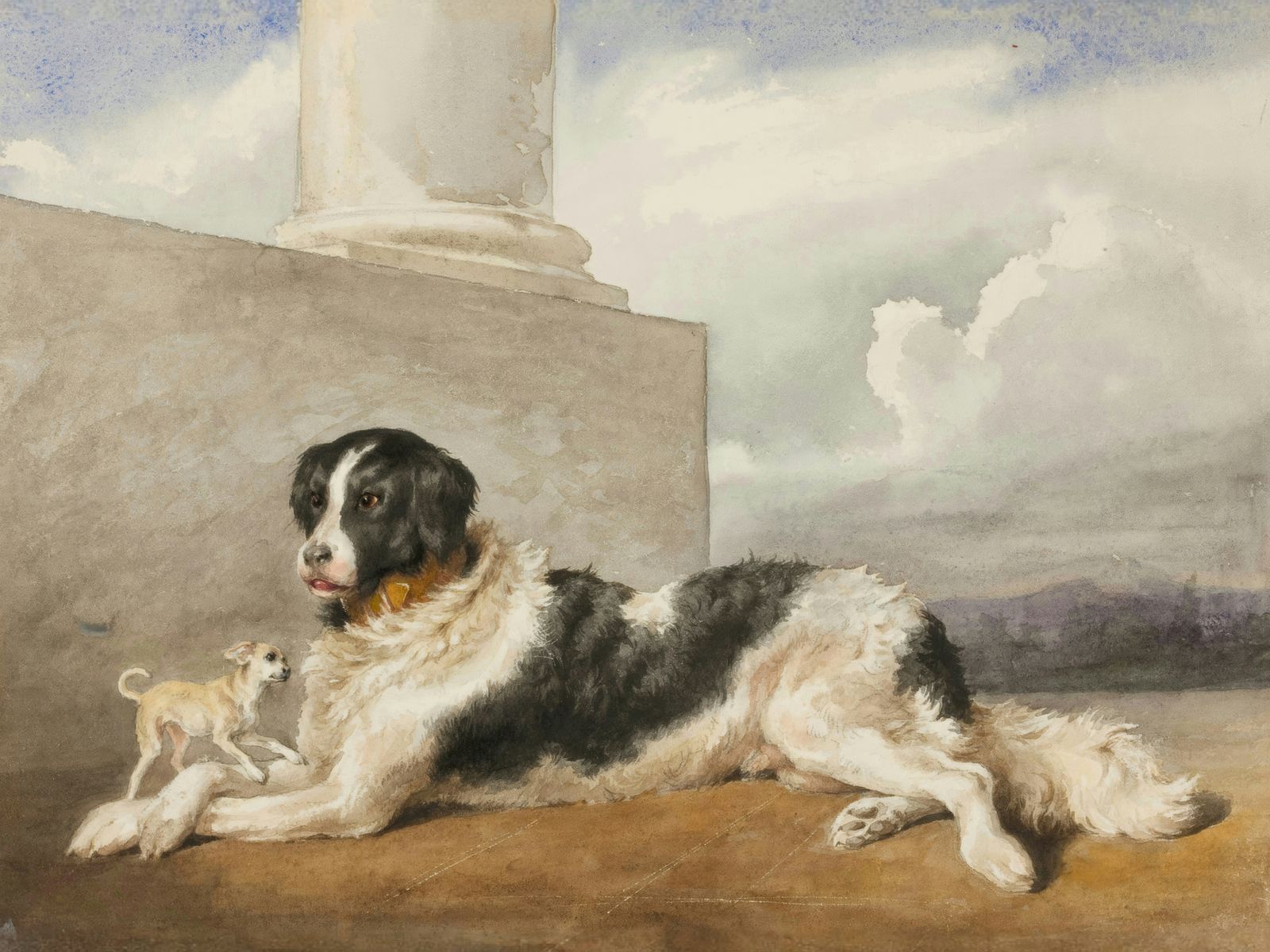
Sultan and Rosette – the dogs of the Czartoryskis — Rosa Bonheur, 1852. National Museum in Warsaw. Prepared for print by Surrealium at Vaxholm Fortress, Sweden.
A close friend may welcome a familiar voice more than a polished sentiment. Use their pet’s name if you know it, and mention one real habit or moment only if you remember it yourself. You do not need to describe the circumstances of the death. These lines offer different starting points; choose one, then add a short sentence that could only have come from you. None requires a reply or asks your friend to feel better on a timetable.
- I am so sorry that you have had to say goodbye. I am here for the quiet days too.
- Your home held so much shared life. I am thinking of you as you miss that familiar company.
- You can tell me the same favourite story as often as you want; I will be glad to hear it.
- I wish I could make this day gentler. You do not need to find the right words with me.
- If you would like company, I can sit with you. We do not have to talk about anything.
- I am remembering how much your pet belonged to the ordinary shape of your days. I am sorry.
- There is room for all the ways you feel about this. You do not have to explain them to me.
- I will miss hearing the little updates that made your pet part of our conversations. Sending you love.
- When you want to share photographs or memories, I would like to look and listen with you.
- I care about you, and I know this loss matters. No reply is needed to this message.
For a family member
Within a family, several people may be grieving differently. Write to the person receiving the card without asking them to comfort everybody else. If the animal was part of your own life, you can say that you miss them too, while leaving the recipient’s experience at the centre. Bonheur’s two resting dogs offer an image of animal companionship; the painting does not supply a story about the family reading your card.
- I am holding you close in my thoughts as the house feels different without such familiar company.
- You do not need to be the person who keeps everyone cheerful today. We can share the sadness.
- I am grateful for the time our family had with your pet, and so sorry for your loss.
- Your pet was part of our family conversations and visits. I will remember that presence with affection.
- We can remember the funny moments and still be sad. There is no need to choose only one feeling.
- If you want help sorting photographs later, I would be glad to do it at your pace.
- I am thinking of the small daily moments you shared, and of how much you may miss them.
- You gave your pet a place in your life. I know saying goodbye to that company is hard.
- I am here as family, with no expectation that you will know what you need straight away.
- Let us keep telling the stories when you feel ready. Your pet will remain part of our memories.
For a colleague or neighbour
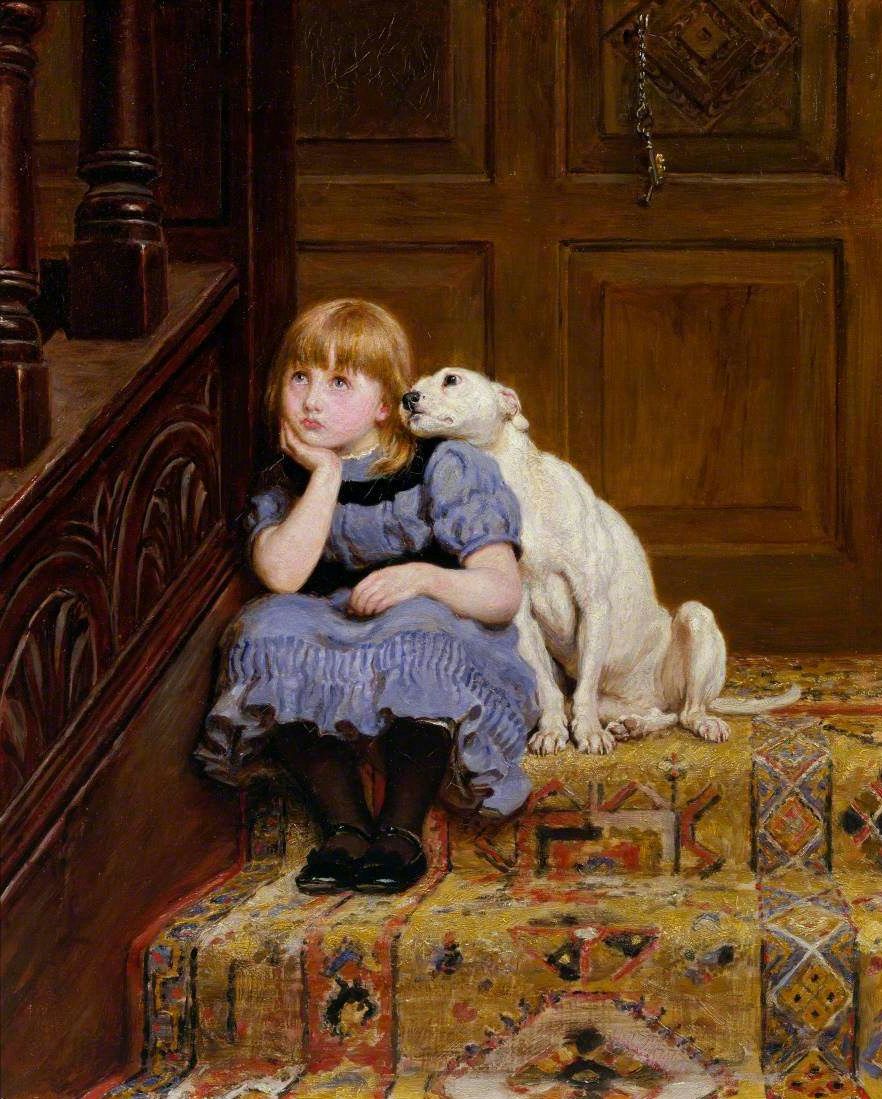
Sympathy — Briton Riviere, c. 1878. Tate, London. Prepared for print by Surrealium at Vaxholm Fortress, Sweden.
A less intimate relationship calls for warmth without intrusion. Acknowledge the loss, keep personal questions out of the card and avoid mentioning details you heard indirectly. An offer of practical help works best when it is something you can actually do. You can also send a message with no offer attached: noticing that the loss matters is already a meaningful reason to write.
- I was sorry to hear about your pet. Please accept my warmest sympathy during this difficult time.
- Thinking of you and the companion you have lost. There is no need to reply to this card.
- I know your pet was an important part of your life. I am very sorry for your loss.
- Sending a quiet note of sympathy. I hope you have space and support around you in the coming days.
- It was always lovely to hear about your pet. I am thinking of you as you say goodbye.
- Please know that your loss has been noticed with care. You do not need to share any details.
- I am sorry that your days have changed in this way. Sending you and your household kind thoughts.
- Your companion was familiar to many of us nearby. I will remember those encounters with affection.
- I wanted to acknowledge your loss rather than let the moment pass without a word. I am sorry.
- Wishing you moments of rest and kind company while you miss your pet. With sincere sympathy.
For a child, with their adult’s guidance
Ask the child’s adult what language the family is using before sending a card. Keep the message simple and do not introduce a religious explanation or an afterlife story the family has not chosen. Avoid asking the child to be brave for somebody else. These lines acknowledge missing an animal and leave room for questions, drawings or silence, without pretending a card can answer everything.
- I am sorry your pet died. It is okay to miss them and to talk about them.
- Your pet mattered to you. I would like to hear a favourite memory whenever you want to share.
- You can draw a picture for your pet if you would like. You do not have to make anything.
- I am thinking of you today. You do not need to hide your tears or find a smile.
- It can feel strange when a familiar friend is no longer at home. You can tell a trusted adult.
- You may feel sad at one moment and want to play at another. Both can happen in the same day.
- I remember how glad you were to see your pet. I am sorry you cannot have that visit now.
- You can ask the adults you trust your questions, even when you have asked the same question before.
- If you want company while you look at photographs, I would be happy to sit beside you.
- Your memories do not have to be big or important. The little everyday things are worth remembering too.
For someone whose pet you never met
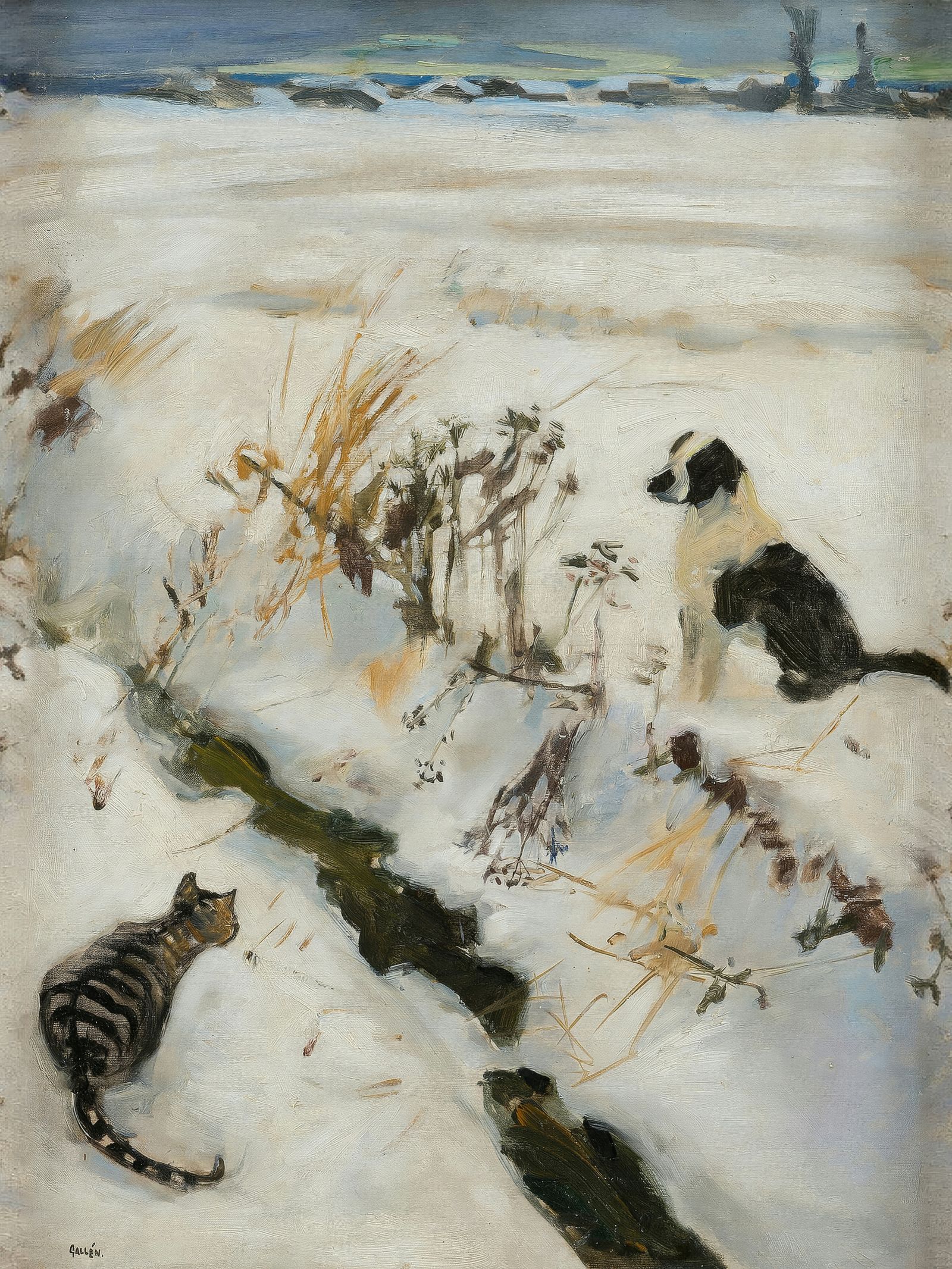
Cat and Dog — Akseli Gallen-Kallela, 1890s. Private collection. Prepared for print by Surrealium at Vaxholm Fortress, Sweden.
You can write sincerely without borrowing a memory. Let the recipient’s own words guide the message: perhaps they often mentioned walks, a morning routine or a pet waiting near their desk. Say that you heard how much the animal mattered, rather than claiming you knew its character. Gallen-Kallela’s cat and dog remain distinct animals across a stream; the image can accompany a gentle card without being made into a metaphor for an afterlife.
- Although I did not meet your pet, I heard the affection in the way you spoke about them.
- I know this companion held an important place in your days. I am sorry you have lost them.
- Your stories helped me understand how much your pet mattered. I am thinking of you with sympathy.
- I cannot share a memory of my own, but I can listen to any you would like to tell.
- I wanted to send a note because your sadness matters, even to someone who never met your pet.
- You spoke of your companion with such care. I am sorry that you are facing this goodbye.
- I am thinking of the routines and small moments you may be missing. No explanation is needed.
- If there is a photograph you would like me to see, I would be glad to see it.
- I do not have perfect words, but I want you to know that I am here and I care.
- Please accept this simple message of sympathy for a companion whose place in your life was their own.
For a later check-in
A card can arrive after the first wave of messages. Mention that you are still thinking of the person without implying that grief ought to have ended. Do not make a later message a request for a progress report. If you offer a walk, meal or visit, leave an easy way to decline and follow through only when it is welcome. The pet sympathy card guide considers choosing the image and format around this kind of message.
- I am still thinking of you and your pet. You do not need to be feeling any particular way.
- A little time has passed, but I have not forgotten your loss. Sending you a quiet hello.
- If you would like company for a walk this week, I would be glad to join you.
- I saw something that reminded me of your pet today. I can share it whenever you would like.
- You are welcome to keep mentioning your companion. Their name does not need to disappear from our conversations.
- I wanted to check in without asking you for an update. There is no need to answer today.
- Some days may bring the absence into focus again. I am here if this is one of them.
- If a familiar date feels difficult, you can tell me. We can find a quiet way to spend it.
- I still remember your pet with affection, and I am thinking of the company you continue to miss.
- Whenever you want to share a small memory, I will make room to hear it. Sending you love.
You do not need a quotation to show that you care. Our pet loss words guide offers another route; if you use somebody else’s quotation, check the author and source rather than trusting an unattributed list.
Read your chosen line once in your own voice. Remove anything that sounds more formal than the relationship, then check the pet’s name and the recipient’s preferred wording. The card’s picture can be as simple as a quiet animal study; you can explore the historic works in Masterworks for visual reference. When the words feel sincere, bring them into the card designer and leave enough space for the message to breathe.
- What should I avoid saying?
- Avoid minimising the loss, comparing it competitively with another loss, promising that time will fix it or suggesting a replacement animal. Do not assume religious beliefs, and do not ask for details about the death.
- Can I send a message after several weeks?
- Yes. A later note can acknowledge that you still remember. Keep it free of expectations about recovery and make clear that a reply is optional.
- Should I use a quotation instead?
- No. A short original message can be enough. If you do choose a quotation, check its author and source rather than trusting an unattributed list.