Marie Antoinette portrait: looking past the costume
A Marie Antoinette portrait presents a public role as well as a face. Read the context through labelled eighteenth-century comparisons.
A Marie Antoinette portrait can seem instantly recognisable as an image of eighteenth-century luxury. That first impression is only a beginning. The queen’s portraits also negotiated public role, clothing, family and the difficulty of presenting a person whose appearance carried political weight. Élisabeth Louise Vigée Le Brun was central to that history, but not every elegant woman she painted was Marie Antoinette.
The portrait shown here is the Comtesse de la Châtre, painted by Vigée Le Brun in 1789. It is not a portrait of the queen. The other illustrations are contextual works by different artists, identified in their captions. They help us consider reading, performance and presentation in eighteenth-century pictures while the discussion of Marie Antoinette’s own portraits rests on documented examples in museum sources.
Identify the sitter before interpreting the dress
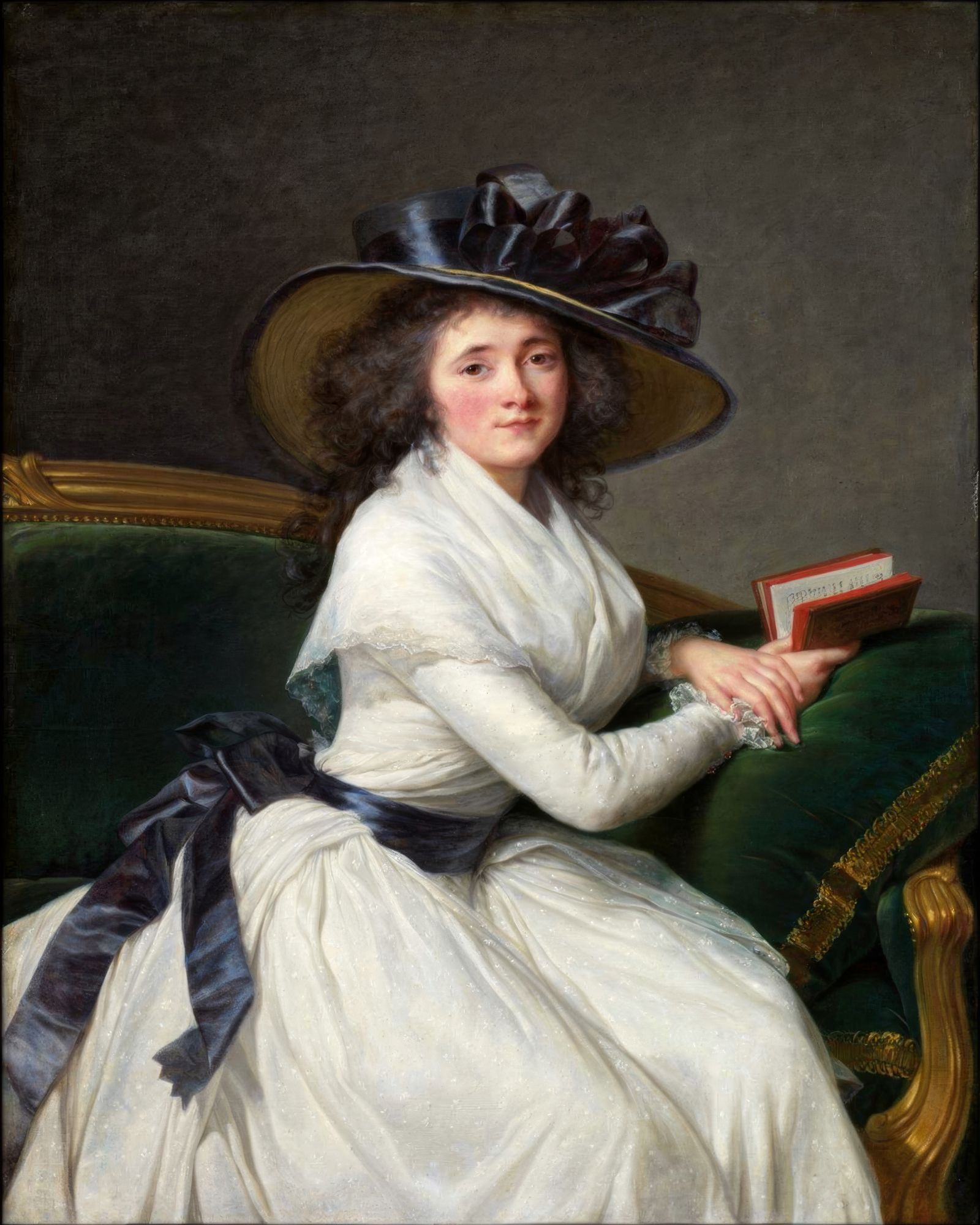
Comtesse de la Châtre · Elisabeth Louise Vigée Le Brun, 1789 · The Metropolitan Museum of Art. Restored by Surrealium at Vaxholm Fortress, Sweden. Contextual portrait; not Marie Antoinette.
A broad resemblance of fashion is not enough to identify a sitter. Pale fabric, an elaborate hat or a poised expression can recur across many portraits made in the same period. The Met identifies the woman shown here as the Comtesse de la Châtre, and that name should remain attached to her image even when it is used to discuss the painter’s wider career. Calling her Marie Antoinette would replace a real person with a more famous search term.
Look at the face, the turn of the body and the relation between the light clothing and the background. These choices help establish the sitter’s presence before we know anything about her biography. They also demonstrate why Vigée Le Brun’s appeal cannot be reduced to a catalogue of fashionable accessories. Our famous portrait paintings story offers a broader comparison of how artists make a person emerge through pose, colour and the space around them. The details of dress become more interesting once they belong to an identified person rather than an anonymous period stereotype.
A queen’s likeness had more than one audience
Marie Antoinette’s portraits circulated within systems of court display and royal representation. A portrait might need to be recognisable as a likeness, appropriate to rank and suitable for a particular setting or audience. Those demands could reinforce one another, but they could also create tension. An image that appeared attractively informal to one viewer might seem unsuitable for a queen to another.
Museum accounts of Vigée Le Brun’s royal portraits document different presentations rather than one fixed image repeated throughout the reign. The 1778 state portrait and the later portrait with the queen’s children belong to distinct circumstances. When you encounter a reproduction, establish which work it is, when it was made and whether you are looking at the original, a copy or a later adaptation. The same face can acquire a different public meaning through clothing, scale, companions and setting. A generic label such as royal glamour can hide those differences instead of helping us see them. The portrait’s intended role is part of its history, not an optional footnote to its appearance.
Reading offers another kind of presentation
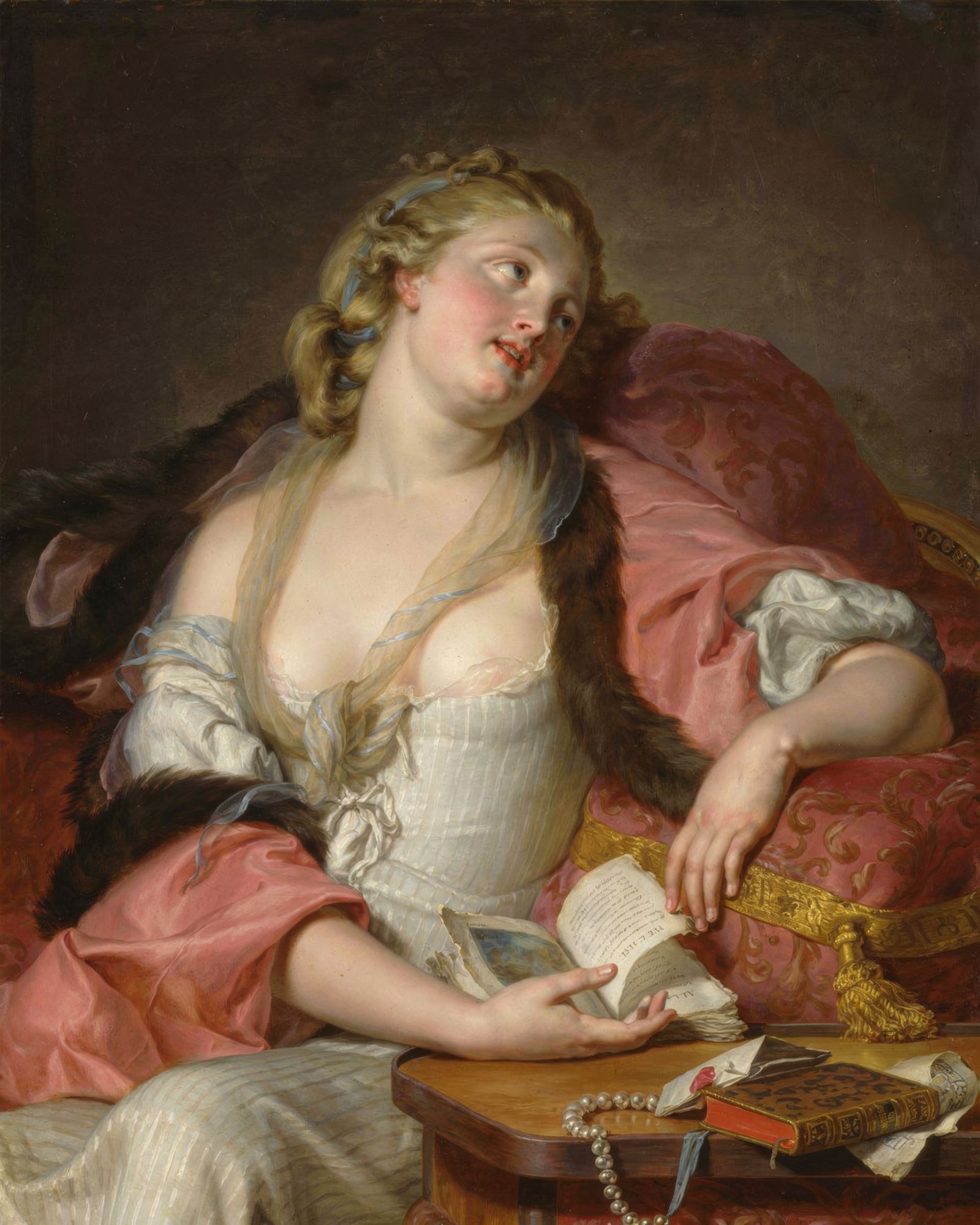
Lady Reading the Letters of Heloise and Abelard · Bernard d'Agesci, c. 1780 · Art Institute of Chicago. Prepared for print by Surrealium at Vaxholm Fortress, Sweden.
Bernard d’Agesci’s reader is a contextual comparison by another artist, not an image of Marie Antoinette. The title identifies her book as the letters of Heloise and Abelard, linking the act of reading to a particular literary and emotional world. Clothing and setting remain important, but the book gives the figure an activity and a possible inward life beyond the display of appearance.
Compare that arrangement with the Comtesse’s portrait. Where does attention seem directed, and what makes the body feel posed or occupied? Neither picture gives us unfiltered access to a woman’s private thoughts. They show ways that a painted figure can be presented to a viewer. Our Rococo art and style story supplies another context for the period’s decorative language, while reminding us that a style label is only a starting point. A work made near the end of the eighteenth century may involve several overlapping traditions and purposes. Describing its actual forms is more useful than forcing every feature into a single period label.
Motherhood became a public argument
Vigée Le Brun’s large portrait of Marie Antoinette with her children, completed in 1787, made the royal family central to the queen’s presentation. The Met’s exhibition catalogue discusses the work within the painter’s career and the circumstances of royal patronage. The choice of companions changes the image’s task: the queen is seen through a family role as well as through rank and personal likeness.
It is tempting to describe such a portrait simply as revealing the real woman behind ceremony. A more careful reading recognises that family presentation can itself be deliberate and public. The presence of children does not turn a commissioned royal picture into an unplanned domestic snapshot. Look for how bodies, gestures, furniture and costume make the group coherent. Our royal portrait guide considers the broader problem of making status visible, including the difference between borrowing a historical visual language and claiming a historical identity for a contemporary sitter. A tender gesture and an official purpose can coexist; the painting need not be reduced to only one of them.
An audience can become part of the picture
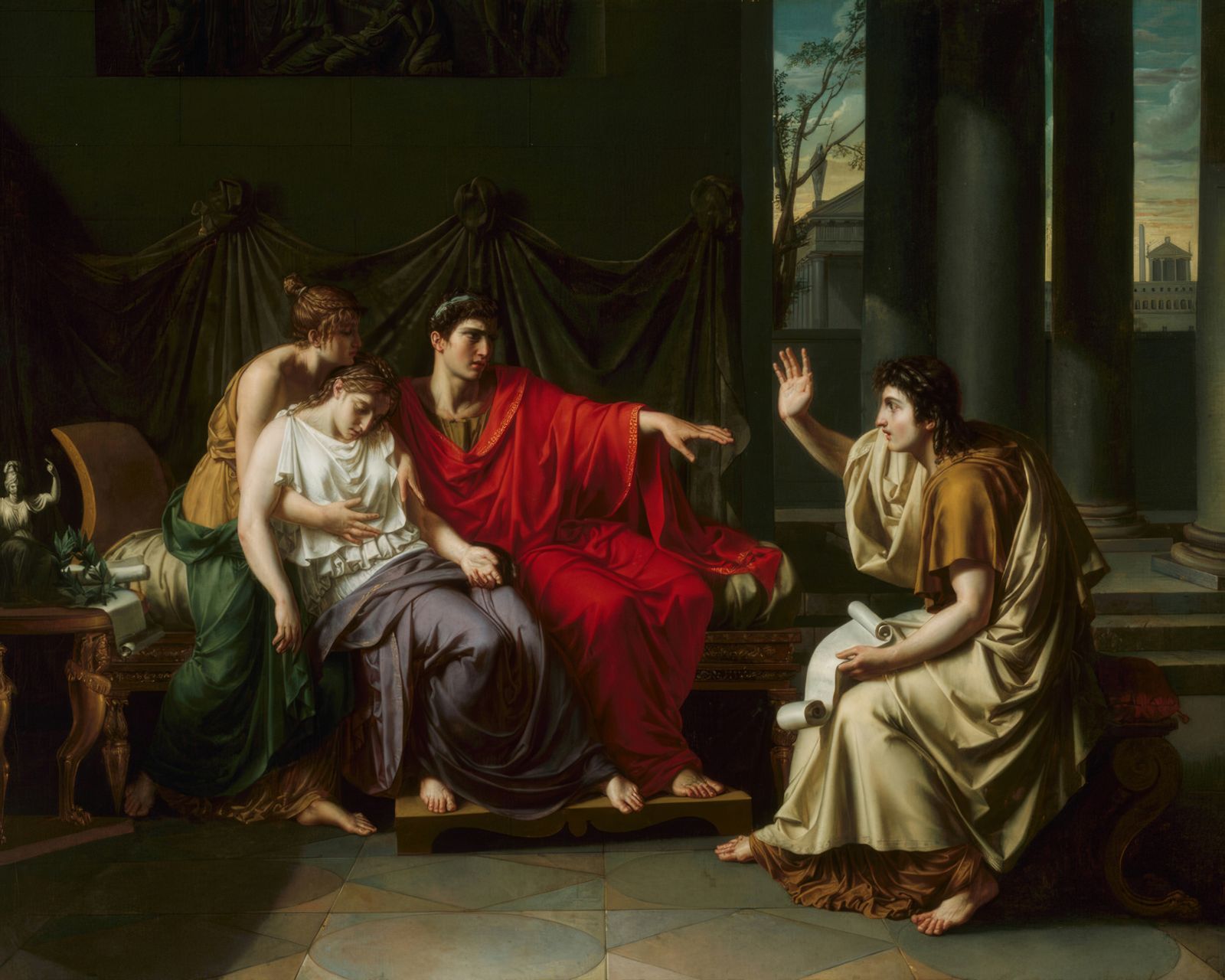
Virgil Reading the Aeneid · Jean Baptiste Joseph Wicar, 1790–93 · Art Institute of Chicago. Prepared for print by Surrealium at Vaxholm Fortress, Sweden.
Wicar’s scene of Virgil reading the Aeneid provides a further eighteenth-century comparison. It depicts a classical episode, not the French royal court, and its figures must not be mistaken for Marie Antoinette or her contemporaries. Its relevance lies in the visible organisation of an audience: gestures and positions show that presentation has an effect on people within the scene.
A portrait also anticipates an audience, even when that audience is outside the frame. The sitter may meet the viewer’s gaze, turn away or appear absorbed in another activity. Those choices affect the kind of encounter the painting offers. Compare the staged classical group with the Comtesse’s individual presence, then ask what you would want from a portrait of yourself or someone close to you. A direct look can feel confident or intimate; a quieter turn can suggest reserve. None of those effects requires copying a queen’s biography or surrounding a sitter with unsupported symbols of rank. The relation between a face and a viewer is already a substantial subject.
Borrow an approach, keep the person
For a contemporary portrait, the most useful lesson may be the relation between face, fabric and background. Begin with a photograph in which the person’s expression and features are clear. Our portrait photo guide helps with that practical decision. Then consider whether you prefer a light, open presentation or a darker, more formal arrangement, without assuming that an elaborate costume will automatically make the likeness convincing.
You can explore current approaches in Styles, or look at historic originals in Masterworks. Keep the distinction between the two experiences clear: one begins with your photograph, while the other lets you choose an existing artwork. When discussing a historical reference, use its actual sitter and title. That small act of precision makes the inspiration richer, because the Comtesse, the queen and a contemporary portrait subject can each remain a separate person rather than collapsing into one fashionable silhouette. A successful reference gives you something to notice while leaving room for the new person’s own presence.
The best first question is simple: who is shown, and what is this particular picture asking that person to represent? Once the sitter and the object are secure, costume becomes evidence to examine rather than a shortcut to identification. The result is a more interesting view of both Marie Antoinette’s portraits and Vigée Le Brun’s art. Our custom portrait guide brings that attention back to a contemporary sitter.
- Is the woman shown here Marie Antoinette?
- No. The principal illustration is Vigée Le Brun’s Comtesse de la Châtre of 1789. Its use as a contextual example is stated throughout.
- Did Vigée Le Brun paint Marie Antoinette?
- Yes. Her documented portraits of the queen include formal royal images and the 1787 portrait with her children.
- Can I use an eighteenth-century portrait as a style reference?
- Yes, as a visual reference for pose, colour or atmosphere. Keep the historic sitter’s identity separate from the person in a new portrait.