Piranesi: ten views between Rome and invention
Compare imaginary interiors with Roman monuments in Fable’s colour editions after Piranesi’s historical prints.
Piranesi made architecture into an experience of looking: stairs redirect the eye, tiny figures change the apparent size of a vault, and a ruin becomes a busy part of a living city. This article concerns Giovanni Battista Piranesi’s historical prints, rather than the novel that shares his surname. The ten images shown here are Fable’s contemporary colour editions after those prints. Their colour is an interpretation, not Piranesi’s original ink palette.
Begin by separating two kinds of image. The Prisons construct imagined interiors; the Views of Rome take named places as their subjects. Neither should be treated as a transparent photograph of a building. Compare them slowly, keeping the complete sheet visible. The dark-art reading room explores a related atmosphere, while classical paintings offers another way artists have used architecture and the ancient past to organise a picture.
1. A staircase that redirects the eye
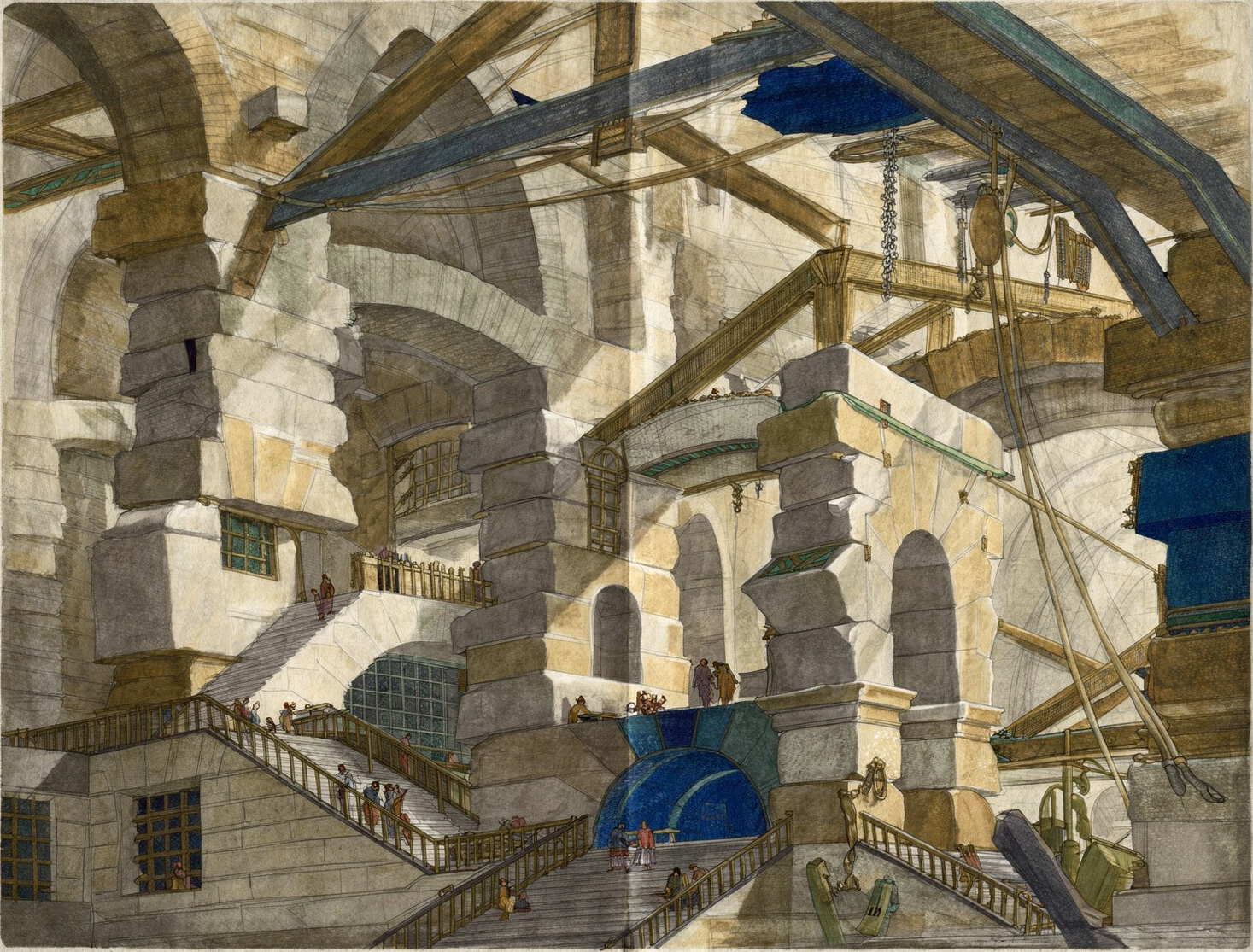
Imaginary Prisons: The Zigzag Staircase · Giovanni Battista Piranesi, 1745–50 · Cleveland Museum of Art. Contemporary Fable colour edition after the historical print. Restored by Surrealium at Vaxholm Fortress, Sweden.
In the perspective of colonnades, steps turn through an interior crowded with supports and suspended structures. The small figures give a measure of scale but do not make the route easy to solve. Try following one staircase until it meets another plane; the interruption is part of the pleasure, and the whole image matters more than a single impressive arch isolated from its surroundings.
2. The Temple of the Sibyl at Tivoli
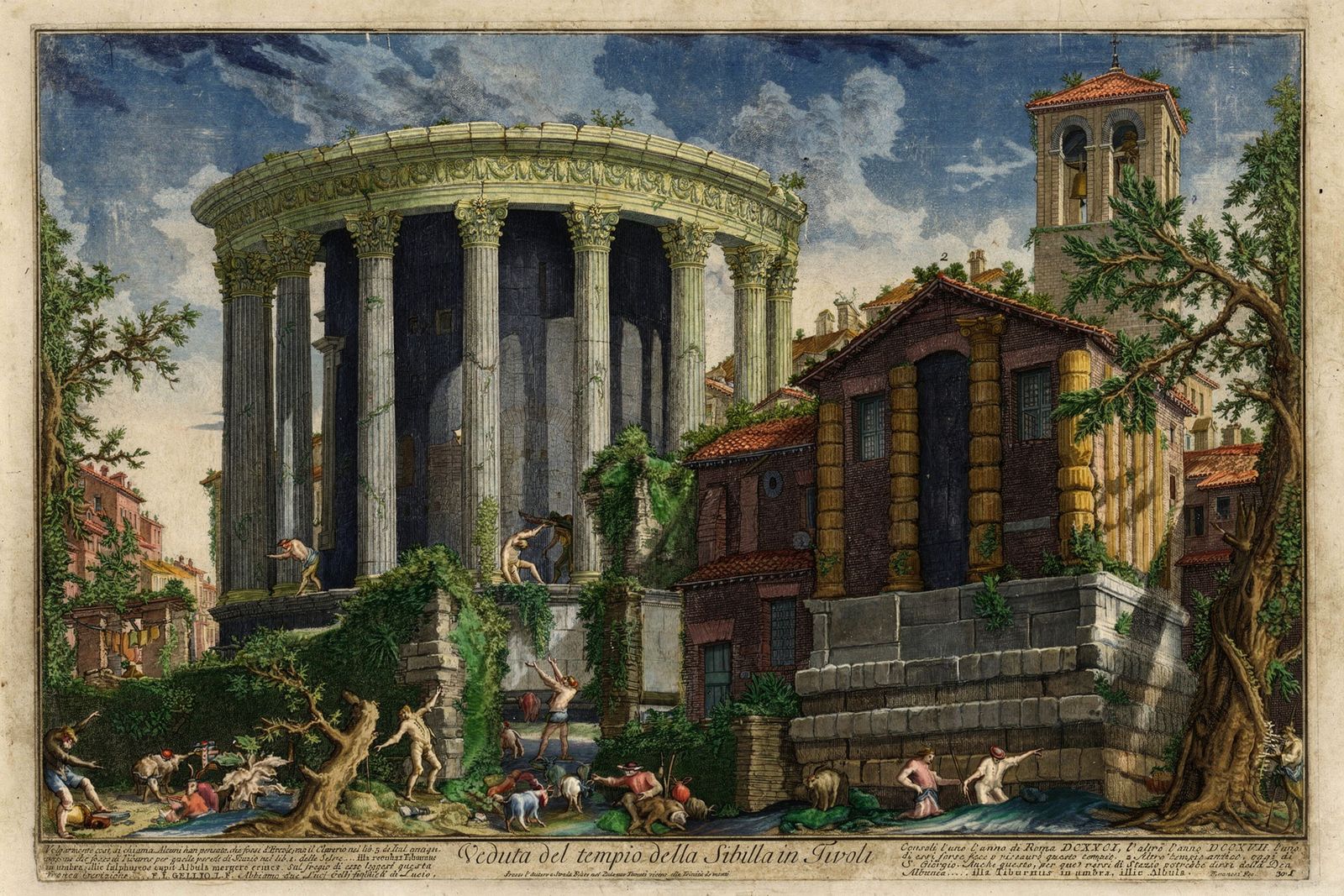
The Temple of the Sibyl at Tivoli · Giovanni Battista Piranesi, c. 1761 · Cleveland Museum of Art. Contemporary Fable colour edition after the historical print. Restored by Surrealium at Vaxholm Fortress, Sweden.
A circular temple stands beside adjoining buildings, with vegetation and figures filling the lower ground. The image holds monument and everyday activity together rather than presenting the ancient structure as an empty diagram. Look at the relation between the columns and the irregular surfaces around them; that contrast lets the temple remain recognisable while the wider scene gives it a particular density and rhythm.
3. The Colosseum from an elevated view
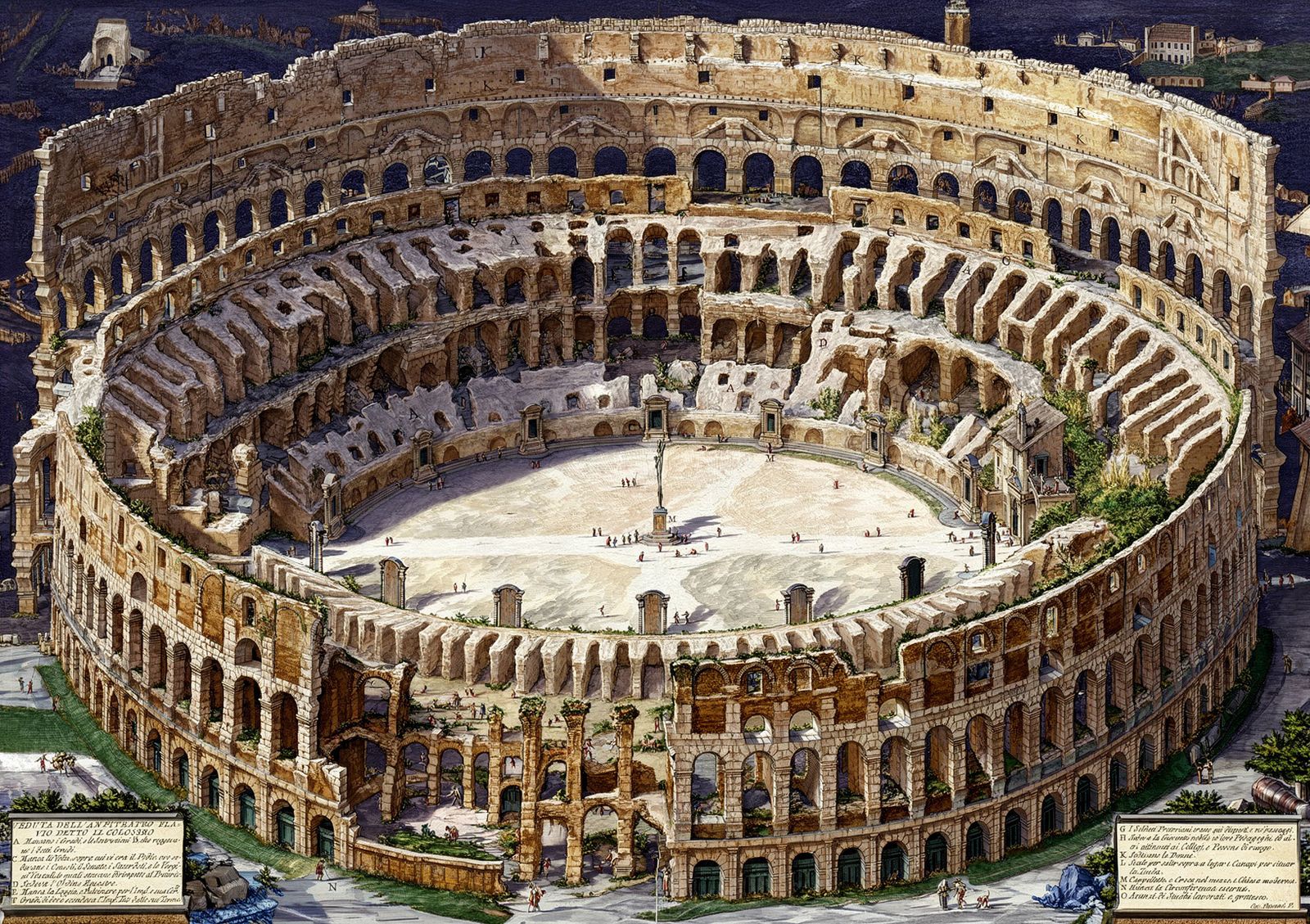
The Colosseum · Giovanni Battista Piranesi, 1776 · Cleveland Museum of Art. Contemporary Fable colour edition after the historical print. Restored by Surrealium at Vaxholm Fortress, Sweden.
The great oval fills much of the composition, its repeated openings wrapping around the arena. The chosen viewpoint makes the building readable as a form while still allowing many small interruptions in its surface. If you are choosing a print, allow enough space to follow those repetitions; a narrow crop would weaken the relationship between the outer ring and the open centre that gives the view its structure.
4. The Pantheon within a changing city
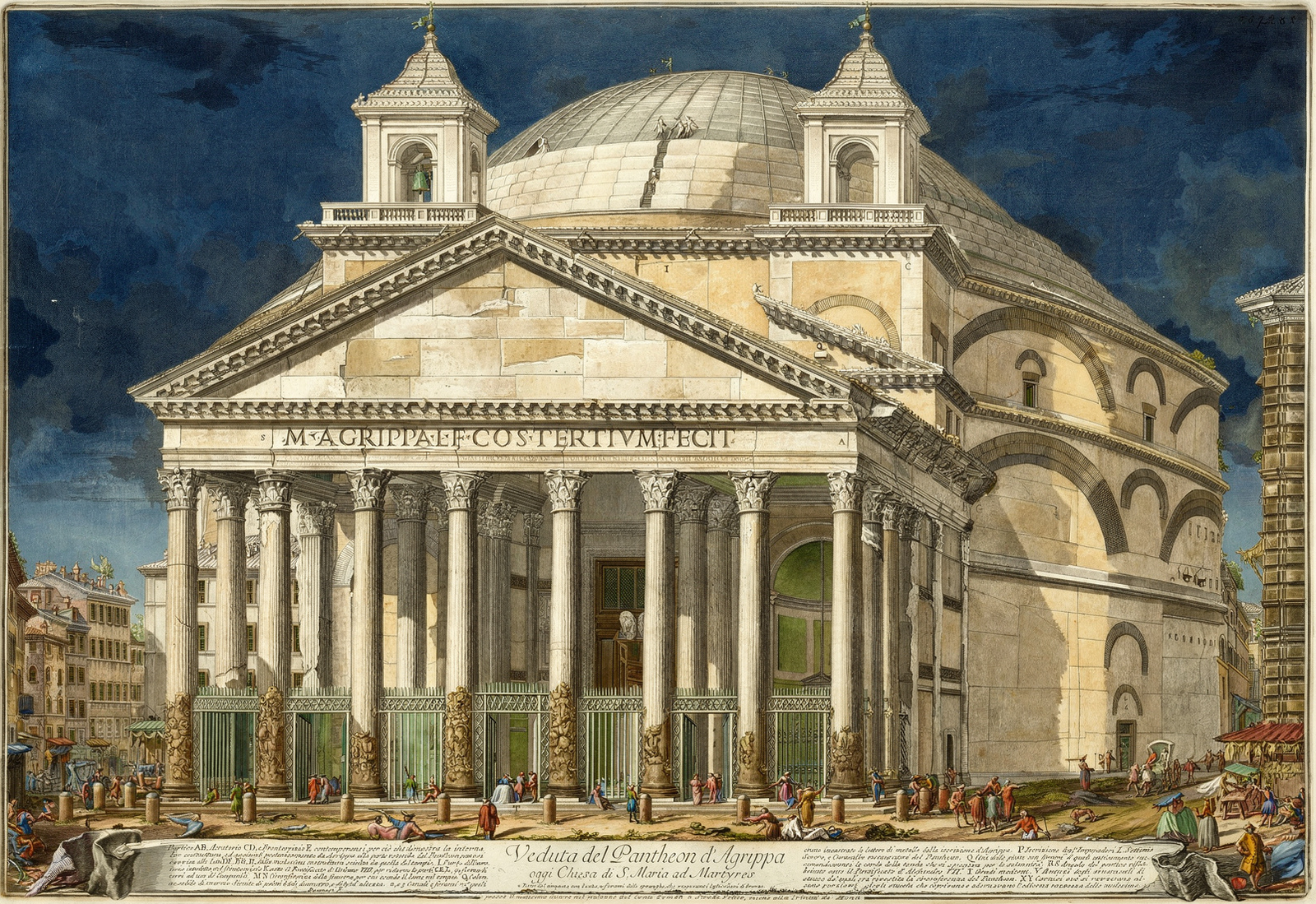
The Pantheon · Giovanni Battista Piranesi, 1761 · Cleveland Museum of Art. Contemporary Fable colour edition after the historical print. Restored by Surrealium at Vaxholm Fortress, Sweden.
The front of the Pantheon faces us with its portico, dome and surrounding buildings all visible. The historical view records a particular presentation of the monument, rather than guaranteeing that every feature corresponds to what a visitor sees today. Read it as an image made in its own time, and notice how people and neighbouring structures prevent the great façade from floating free of the city around it.
5. A wide hall with lanterns
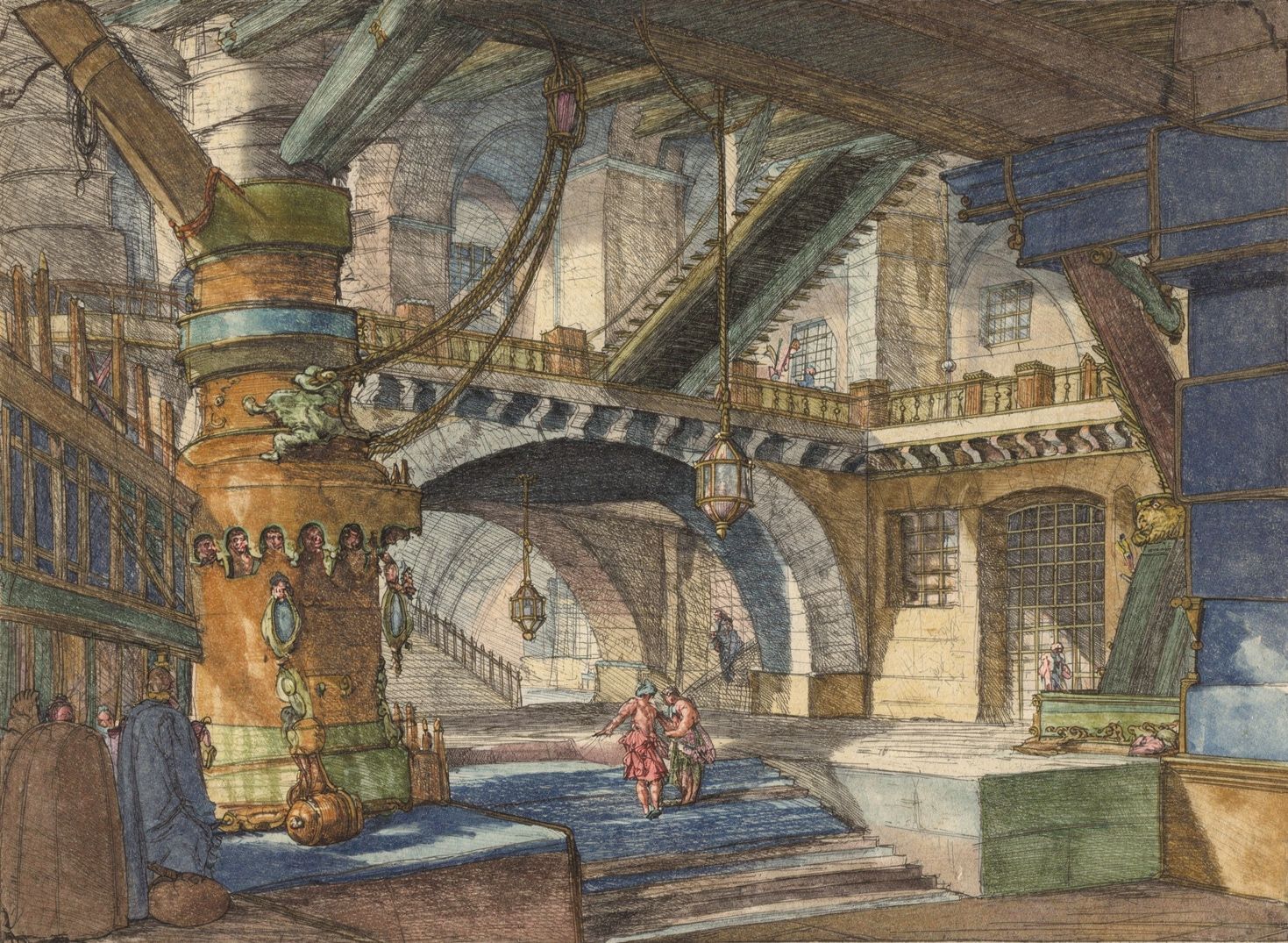
Imaginary Prisons: The Hall with Lanterns · Giovanni Battista Piranesi, 1745–50 · Cleveland Museum of Art. Contemporary Fable colour edition after the historical print. Restored by Surrealium at Vaxholm Fortress, Sweden.
The imagined hall expands through arches, platforms and hanging forms, with light catching selected surfaces. The eye can move a long way without finding a simple destination. In Fable’s colour edition, different planes become easier to separate, but the architectural invention remains in the underlying print; it is helpful to distinguish that structure from the modern treatment through which you are seeing it here.
6. An arched chamber with posts and chains
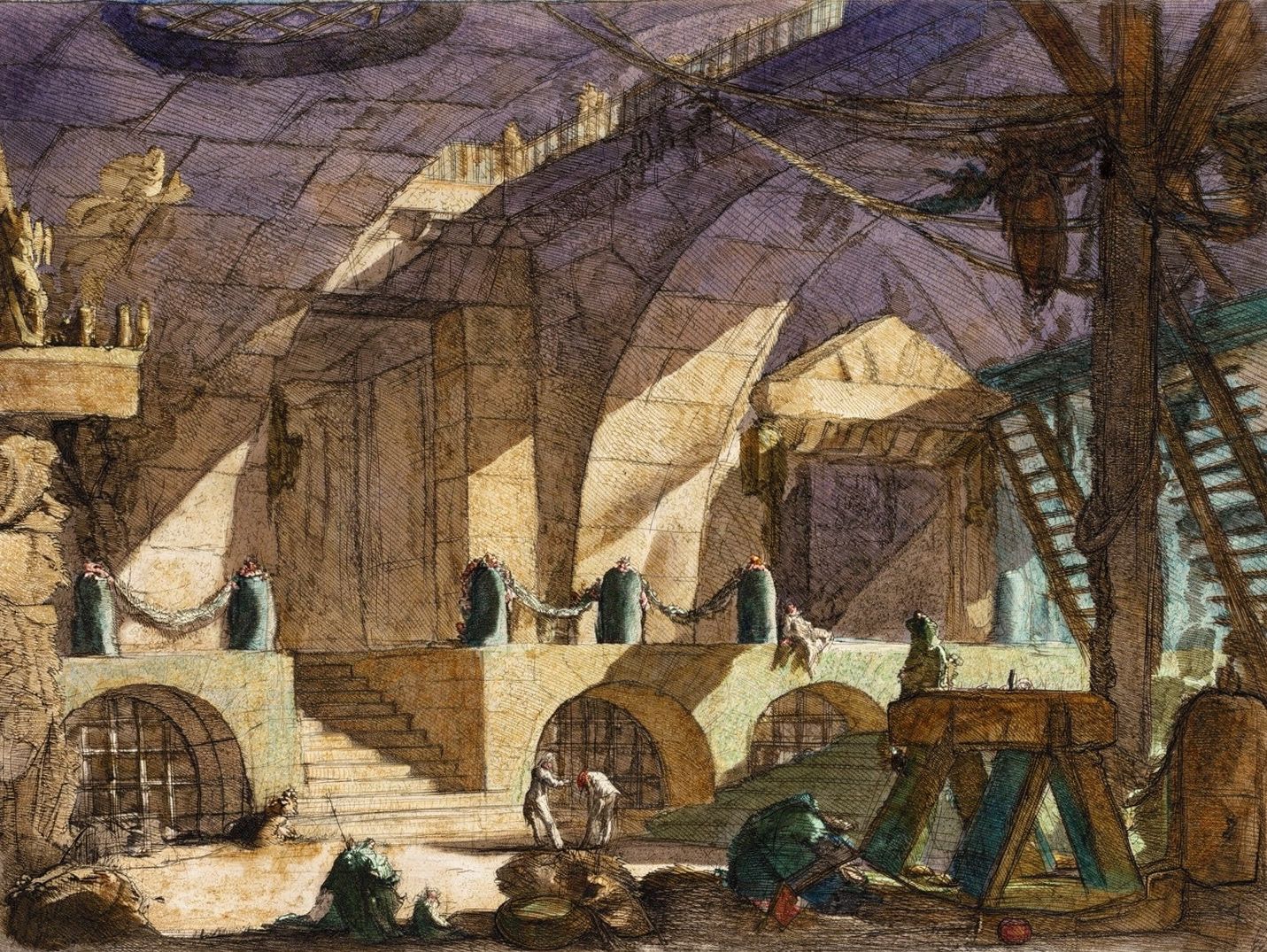
Imaginary Prisons: The Arched Chamber · Giovanni Battista Piranesi, 1745–50 · Cleveland Museum of Art. Contemporary Fable colour edition after the historical print. Restored by Surrealium at Vaxholm Fortress, Sweden.
Heavy posts and chains introduce another scale within the vast chamber. The foreground objects feel close enough to obstruct us, while the distant architecture continues beyond them. This combination makes the viewer’s position uncertain: we can inspect the scene, but we cannot easily imagine walking through it along one stable route, which is more interesting than treating the image as a plan for a possible building.
7. The Forum of Nerva among other lives
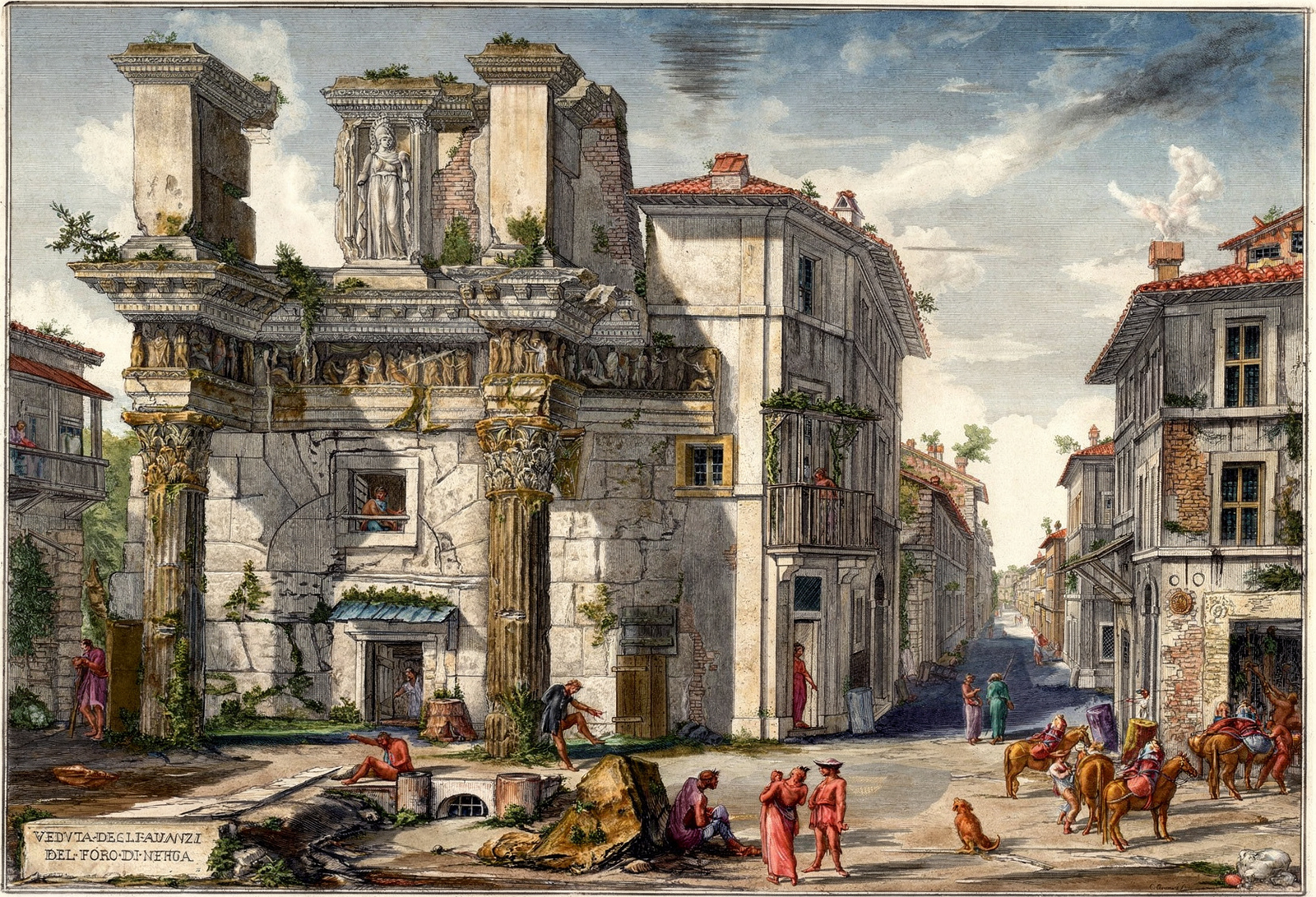
The Forum of Nerva · Giovanni Battista Piranesi, c. 1770 · Cleveland Museum of Art. Contemporary Fable colour edition after the historical print. Restored by Surrealium at Vaxholm Fortress, Sweden.
Ancient columns and fragments appear beside later buildings and small figures. The contrast is not only between old and new stone; it is between the great scale of the ruin and the ordinary activity around it. Give the foreground time before moving to the tallest surviving forms, because the smaller elements help explain how the monument becomes part of a composed city view.
8. The Tiber island as a layered edge
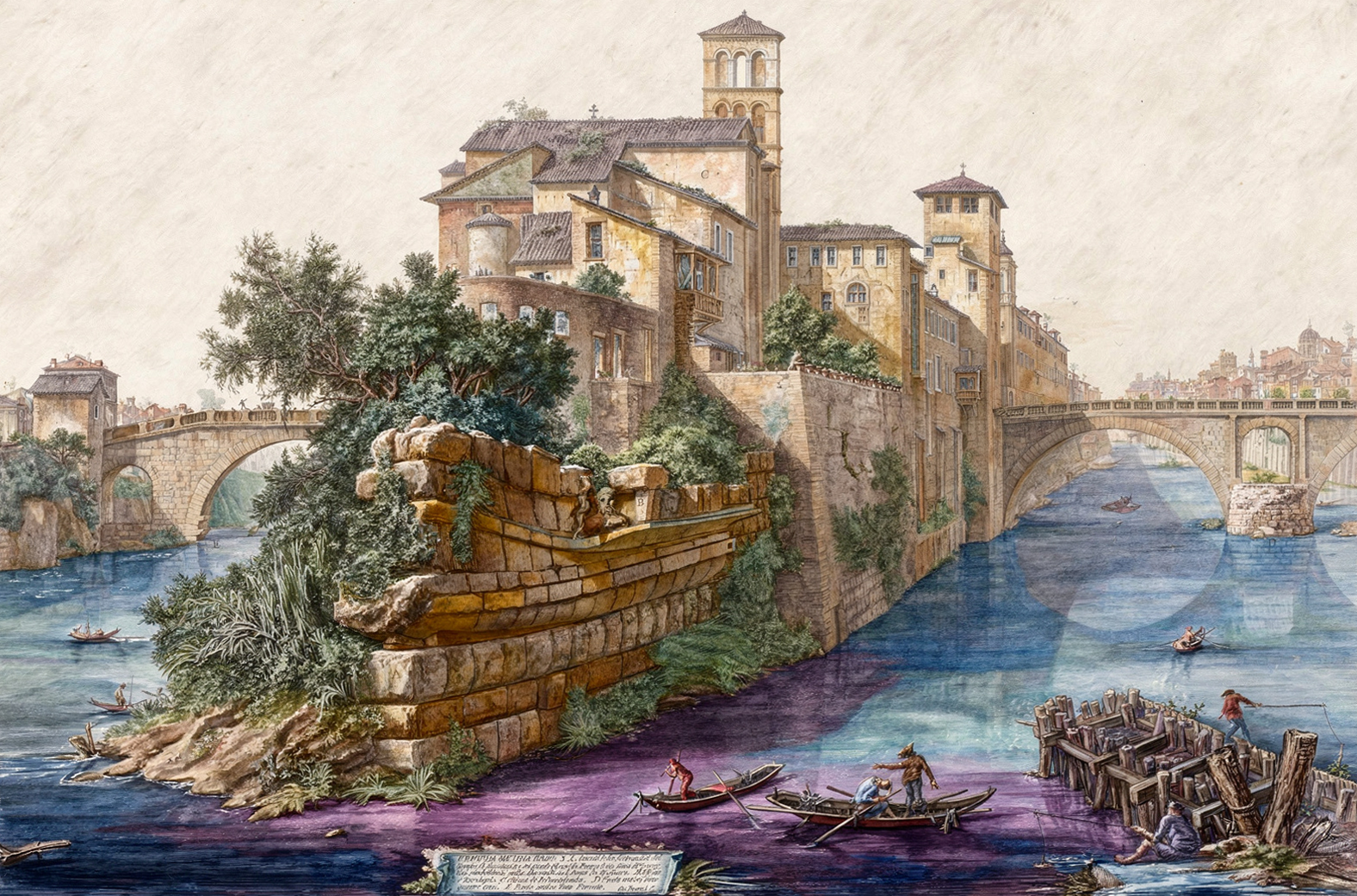
The Isola Tiberina · Giovanni Battista Piranesi, 1775 · Cleveland Museum of Art. Contemporary Fable colour edition after the historical print. Restored by Surrealium at Vaxholm Fortress, Sweden.
The island view places buildings above the water, with boats and banks spreading the scene horizontally. It gives a different rhythm from the enclosed Prisons: instead of looking upward through vaults, the eye travels along an edge. Compare the masonry at the waterline with the lighter structures above; the picture’s interest lies in their accumulation, not only in recognising a named location.
9. The aqueduct of Nero as a passage through ruins
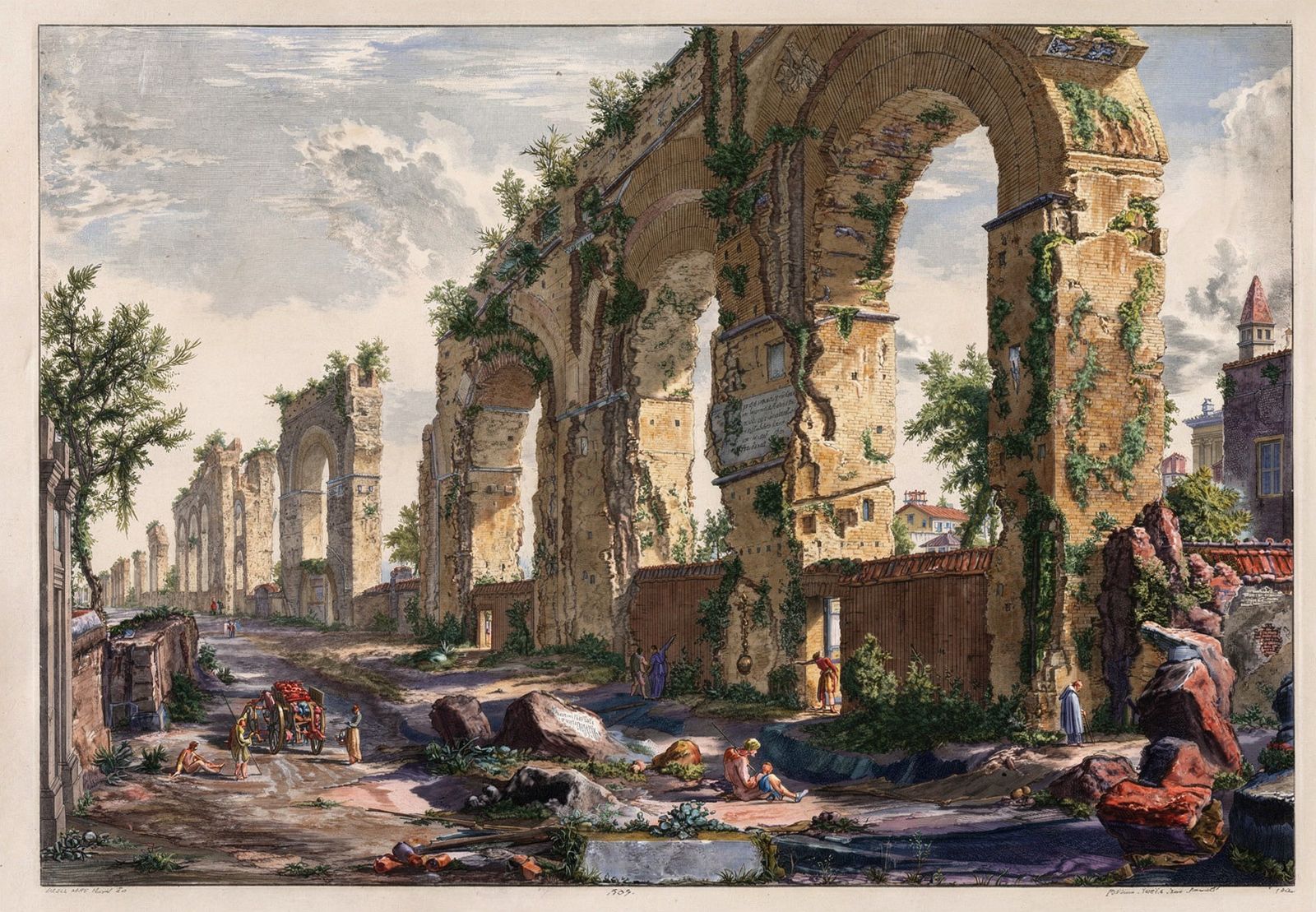
The Aqueduct of Nero · Giovanni Battista Piranesi, 1775 · Cleveland Museum of Art. Contemporary Fable colour edition after the historical print. Restored by Surrealium at Vaxholm Fortress, Sweden.
Broken arches rise over a ground occupied by vegetation, people and scattered stone. Openings in the structure repeatedly reveal another part of the view, so the ruin acts as a series of frames within the image. Follow those openings rather than searching only for a central monument; the composition makes damage and incompleteness into ways of seeing through the scene.
10. The so-called Tempio della Tosse
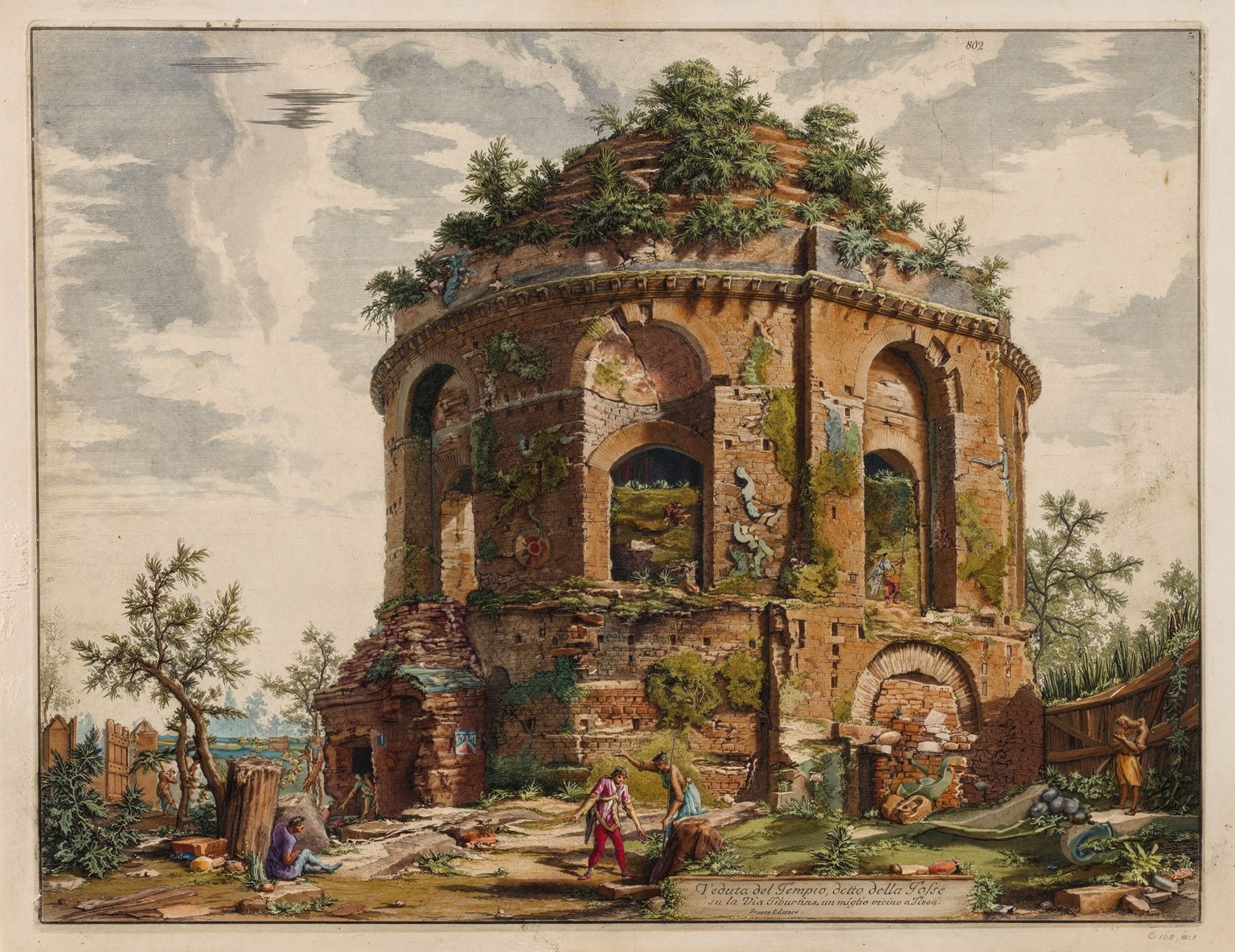
The Temple of the Cough, near Tivoli · Giovanni Battista Piranesi, 1763 · Cleveland Museum of Art. Contemporary Fable colour edition after the historical print. Restored by Surrealium at Vaxholm Fortress, Sweden.
A round building stands close to the viewer, its worn surfaces and growing vegetation clearly differentiated. The historical title’s “so-called” is worth retaining because names attached to ancient structures can outlast certainty about their original use. Look at the building as Piranesi presents it here, and resist supplying an unsupported story simply because the architecture feels old enough to invite one.
Choose between the Prisons and the Roman views by the kind of space you want to revisit. One unsettles orientation; the other ties an architectural image to a named place, though still through an artist’s decisions. Victorian paintings show later artists building very different kinds of historical imagination, and the Masterworks collection lets you compare these complete images directly.
Keep the edition description with the print. A contemporary colour treatment can be enjoyed on its own terms without being mistaken for an eighteenth-century coloured impression. Look for enough room to read the small figures and repeated structures, and let the work’s own proportions determine the arrangement rather than reducing a complex horizontal view to a convenient square.
The Rococo collection offers the catalogue setting for these prints; the Rossetti story provides a different artist’s use of dense imagery.
- Were Piranesi’s Prisons real buildings?
- The Prisons are imagined architectural scenes. They use convincing fragments and changes of scale, but they are not straightforward records of a single prison a visitor could reconstruct from the images.
- Are the colours shown here Piranesi’s original colours?
- No. These are contemporary Fable colour editions after historical prints. The captions distinguish the underlying work from that later treatment; the colours should not be used as evidence of the artist’s original printed palette.
- Does this article concern the novel Piranesi?
- No. The subject is the historical artist and his prints of imagined architecture and Roman sites. The shared name makes the search term ambiguous, so the distinction matters when choosing a picture or looking for further reading.