Medieval heraldry: signs made for recognition
A medieval painting and two later prints show how heraldry carries identity, while keeping period and bearer clear.
Medieval heraldry used recognisable signs to express identity, affiliation and status. Its history is more particular than a universal dictionary in which every animal stands for one virtue. A device belonged to a bearer and a context, and the same visual language could appear on a shield, a seal, a building or an object associated with patronage.
The central historical example here is Hans Memling’s Annunciation of about 1465–70. The Met identifies joined keys associated with the Clugny family in its carpet and stained glass, linking the picture to a likely commission for Ferry de Clugny. Two Dürer armorial prints from 1503 follow as later comparisons; they are not presented as medieval objects. Their Fable colour editions also belong to a modern layer of interpretation. Start with what a coat of arms is for the terms, then look at how a documented sign occupies a real work of art rather than treating heraldry as a collection of interchangeable motifs.
Recognition comes before a dictionary of meanings
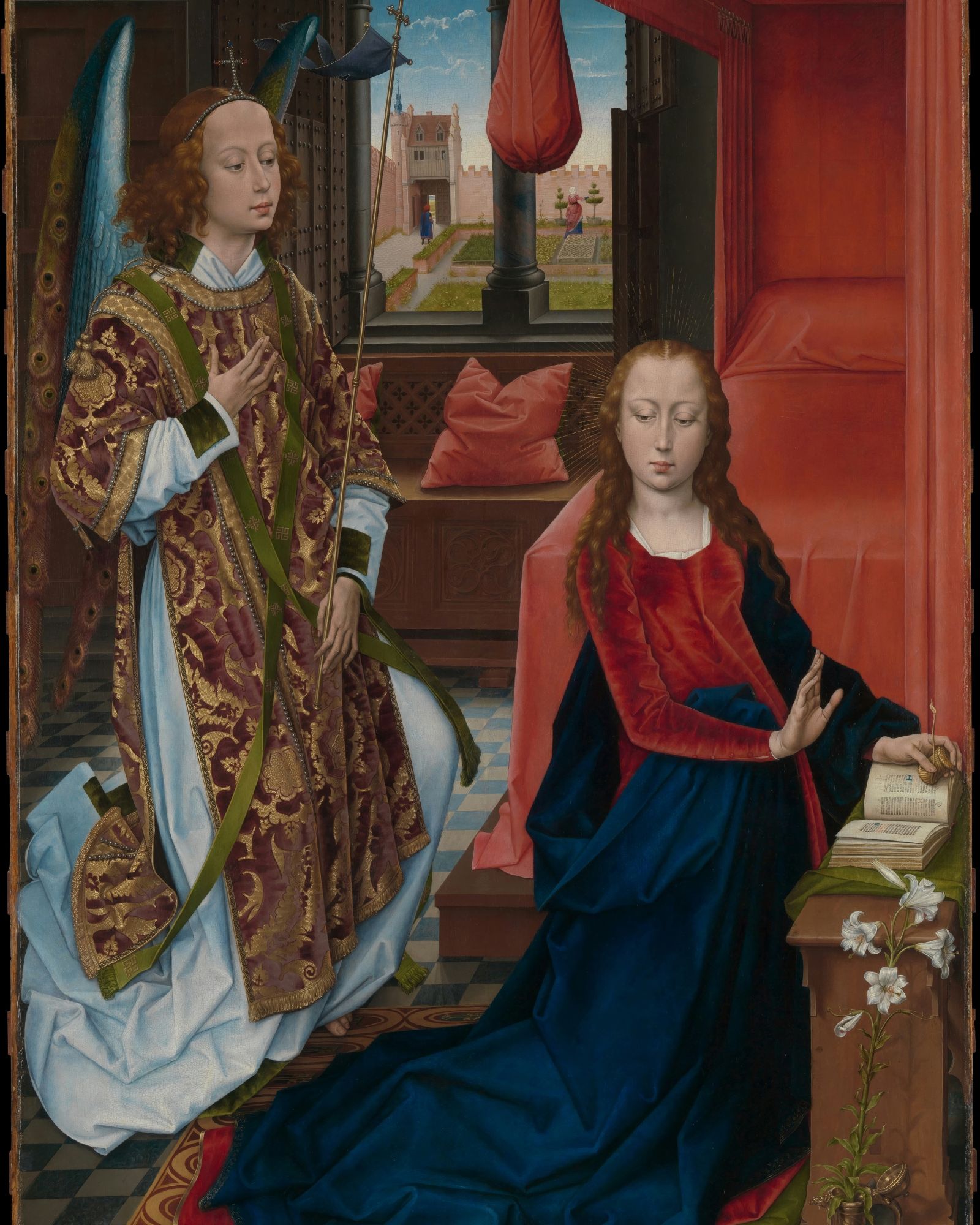
The Annunciation · Hans Memling, ca. 1465–70 · The Metropolitan Museum of Art. Restored by Surrealium at Vaxholm Fortress, Sweden.
A heraldic device needs to remain recognisable in a particular setting. That practical problem helps explain why strong shapes and clear relationships matter so much. An arrangement seen on a shield at a distance and a small impression on a seal have different physical conditions, but both depend on a design that can retain its identity when detail is limited.
The Heraldry Society places the emergence of hereditary shield devices in the twelfth century. That broad historical development should not be confused with the origin of every individual charge. A lion, a star or a tree does not acquire one fixed meaning that applies across all places and centuries. For a specific example, ask who bore it, where it appears and what source documents the connection. The guide to heraldic symbols offers a useful vocabulary, but the historical work remains the evidence. A confident-looking interpretation is less useful than a modest description tied to an identifiable bearer and object.
Read the arms inside Memling’s room
Memling’s Annunciation surrounds its figures with a carefully furnished interior. The heraldic references are not the largest objects in the scene, yet they connect the religious picture with a particular patronage context. The Met points to the joined keys in the carpet and stained glass when discussing the likely Clugny commission. Those details matter because they are placed within the work, not added by a later viewer searching for a family resemblance.
Look first at the entire room, then find the smaller areas in which the devices appear. Their scale changes the way they operate: they do not interrupt the sacred narrative with a separate portrait, but they still leave a sign of association. This is a useful reminder that heraldry can be woven into another subject. The Annunciation painting guide follows the figures and setting more closely. Here, the lesson is about evidence: the connection comes from a museum’s reading of specific visible details, not from the surname of someone who happens to enjoy the image today.
A later print can clarify the parts
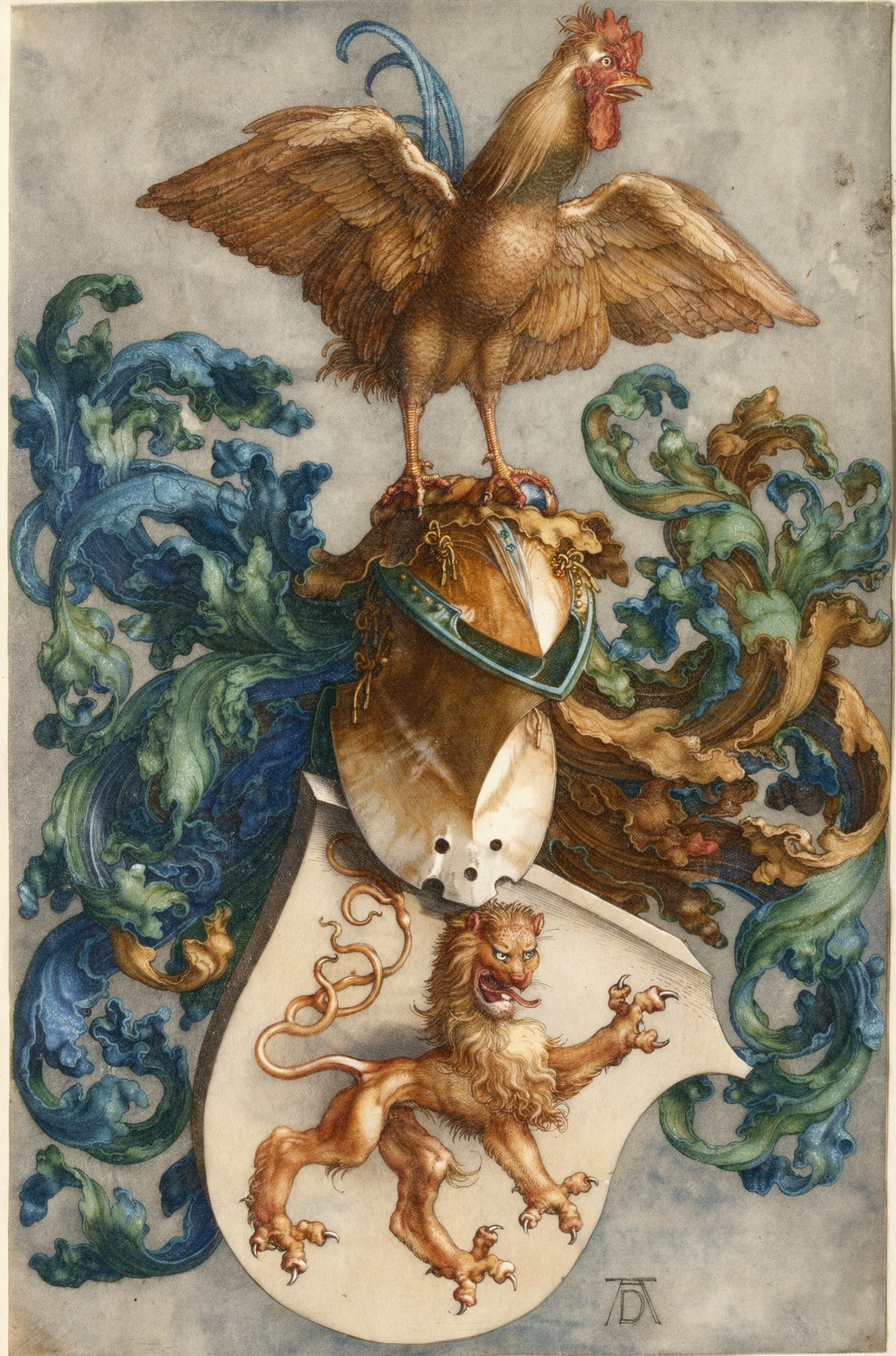
The Coat of Arms with a Lion and Cock · Albrecht Dürer, probably 1503 · Cleveland Museum of Art. Contemporary Fable colour edition after the historical print. Restored by Surrealium at Vaxholm Fortress, Sweden.
Dürer’s Coat of Arms with a Lion and Cock, dated 1503, is a later comparison with a more explicitly armorial arrangement. The shield and upper elements are gathered into a complete composition, giving the viewer a different way to inspect the relationship between a charge and its surroundings. The historical date belongs to the print; the colour in the displayed Fable edition is contemporary.
Calling this a comparison keeps the chronology useful. A work made after the medieval period can help explain the continuing visual language without becoming evidence that every detail was used in the same way centuries earlier. Look at how the main elements remain distinct even within an elaborate whole. If you are interested in making a new decorative emblem, that clarity is a practical lesson. It does not require copying the historic design or claiming a relationship to its bearer. The guide to making a coat of arms develops that separate creative task while keeping the historical reference attached to its own identity.
Do not make a surname do the work of a record
A search for a surname often produces an attractive shield with little explanation of who used it. The visual confidence of the result can conceal the missing information. A historical attribution needs a bearer, a source and enough context to distinguish that person or lineage from other people with the same name. Sharing the spelling does not establish the connection by itself.
The College of Arms explains arms in relation to particular people and families, rather than treating a surname as a universal entitlement. For a historical investigation, preserve the wording of the document and the identity of the bearer before attempting a wider conclusion. For a decorative design, you can choose a different path entirely: make a new emblem and describe it as new. The family crest research guide helps separate those questions. Neither a printed surname chart nor a familiar-looking animal can replace the documentary steps when the claim being made is about ancestry rather than personal taste.
Notice how an armorial image can become dramatic
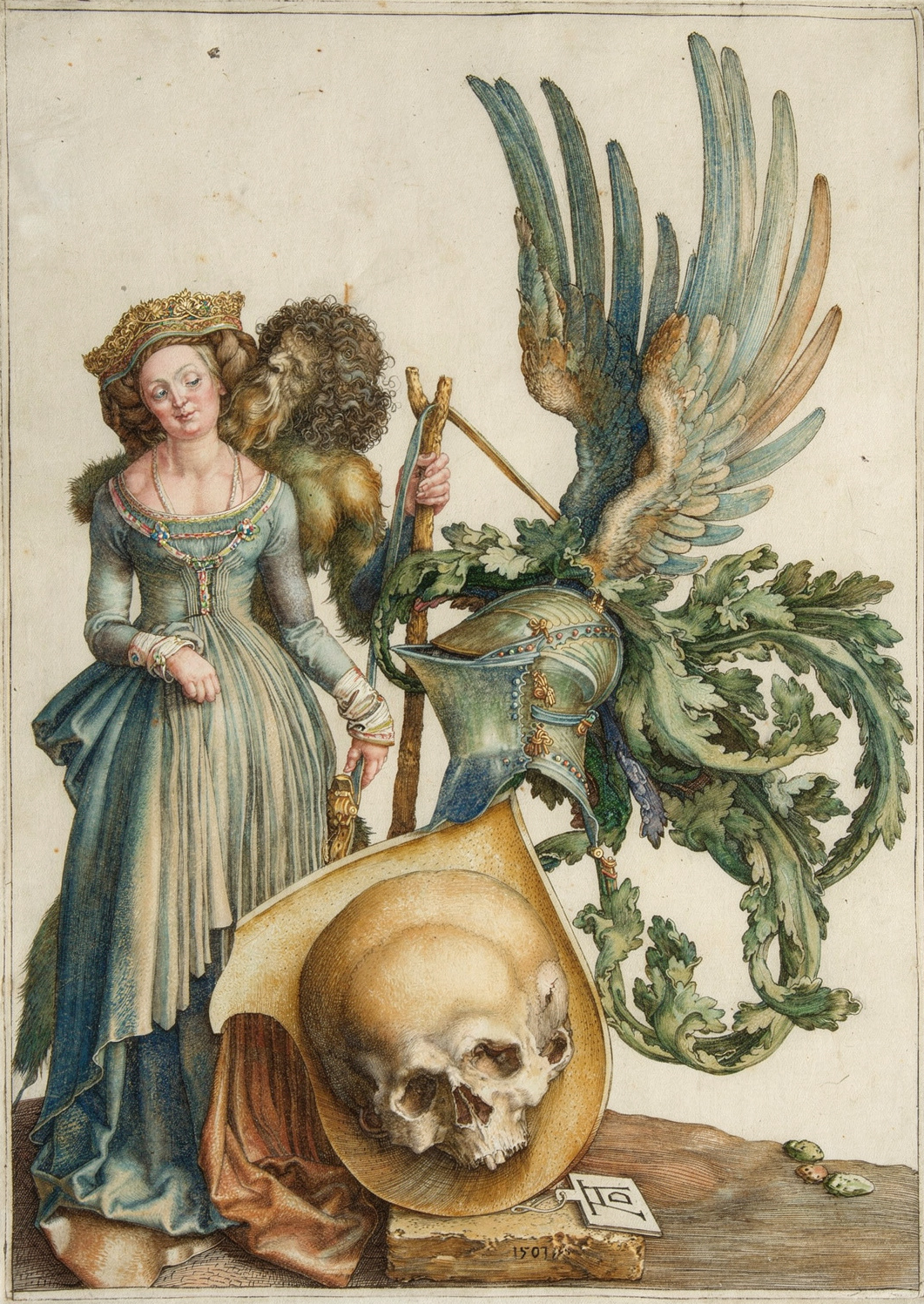
Coat of Arms with a Skull · Artist: Albrecht Dürer, 1503 · The Metropolitan Museum of Art. Contemporary Fable colour edition after the historical print. Restored by Surrealium at Vaxholm Fortress, Sweden.
Coat of Arms with a Skull presents a very different atmosphere from the domestic room in Memling’s painting. The skull and surrounding forms make the image feel charged before the viewer has analysed its heraldic parts. It is another Dürer print from 1503, shown in a Fable colour edition, and should be read as that particular work rather than a universal template for medieval shields.
Compare the degree of emphasis. In Memling, a heraldic sign is embedded within a larger religious scene. Here, the armorial construction becomes the main encounter. That change in presentation affects how you look, even when you cannot identify every detail. It also warns against reducing heraldry to attractive decoration alone: historical images can carry themes that do not suit a modern personal emblem. Spend time with the whole work before choosing a reference because of one compelling shape. An image can be useful for studying composition without being an appropriate design to reproduce on a wedding invitation or a family note.
Use historical forms without inventing a past
If medieval heraldry interests you as a visual language, begin with the qualities you can observe: a clear outline, a repeated shape, a contrast between the field and its charge, or a device placed within architecture. Those qualities can inform a new decorative design without needing a story about inherited status. Write the intended use in ordinary words before selecting a motif.
Browse Renaissance Masterworks to compare the later prints in their period setting. Then decide whether your task is historical research, appreciation of an artwork or the making of a new emblem. Each asks for a different kind of evidence and a different final description. A researched historical design should identify its bearer and source. A print should identify the work and any modern colour treatment. A new Fable Heraldry output should be called a new decorative design. Keeping those descriptions separate makes the visual connection with the past more interesting, because it does not depend on pretending that the three objects are the same thing.
The most useful way into medieval heraldry is through a documented example. Memling’s small joined keys show how a sign can connect patronage, identity and a larger painted subject. The later Dürer prints let you compare a more concentrated armorial arrangement while preserving the difference in date and presentation.
If you want to design something new, take the clarity of the forms as inspiration. Choose symbols for reasons you can explain, and give the result an honest description. A decorative crest can belong to your present life without requiring an invented medieval history.
For two different later uses of medieval imagery, compare Saint George and the dragon with knights and ladies in romantic painting.
- When did medieval heraldry develop?
- Hereditary shield devices emerged in the twelfth century. Individual examples still need their own dates and sources; that broad history does not establish the origin or meaning of every motif.
- Is every old-looking shield medieval?
- No. The Dürer prints shown here date to 1503 and are included as later comparisons. A contemporary colour edition adds another layer, which should also be named rather than folded into the historical date.
- Can a surname search prove that particular arms belong to me?
- No. A surname match is not enough to establish a connection to a historical bearer. Identify the person, object and documentary source before making a claim about ancestry or inherited arms.